Showing posts with label internet. Show all posts

Monday, September 12, 2011

Accuracy in ROI

Last week on the Not-So-Secret Writings of ScLoHo, I shared the story of using technology to modernize a retail operation.

I admit, when I moved from the radio business to the web world this year, one of the reasons was the ability to measure with accuracy the Return On Investment of the actions we do online.

But you have to connect all the dots.....

The Truth?


Recently I was doing some exploratory work at a car dealership and was amazed at how they manage inventory, and their internet presence.

They can tell how many people have visited their website, which vehicles they looked at, what links they clicked on, etc.

I mean, this is one slick technology rich business.

But there was one part that stuck out as a fatal flaw.

The final tracking device.

They hand the customer a piece of paper with several options of how they heard about the dealership and ask them to circle one.

At first I thought using pictures and drawing a circle was clever. It is.

But.

It's not accurate.

It relies on a customer to recall something that they really don't care about.

And this type of tracking is highly unreliable.

If you have the technology to track but then end up with a flawed link, then you better find a better way, or at least realize that you're dealing with bad data.

The words of Scott Howard aka ScLoHo

Sphere: Related Content

Monday, September 05, 2011

Mobile, Mobile, & More Mobile


I want a tablet.

Yes, an iPad would be dandy, but I may consider a different brand.

And I'm not the only one: Mobile as an E-Commerce Supplement The buzz around mobile applications, mobile design and mobile advertising can distract Internet retailers from their core mission, which is to sell products.

Today's most successful e-commerce merchants, however, understand how to best use these technologies and platforms to increase revenue and deepen engagement.

The most effective way to do that is by using mobile as a supplement to an existing website's promotional efforts. Below we will explore several strategies for excelling in what has become a challenging and competitive environment.

For several years now, online retailers have anticipated and prepared for a dramatic rise in mobile commerce. Many have gone so far as to invest in elaborate applications or optimized their websites specifically for smartphone and tablet users. What the Internet retailing community has learned in the past year, however, is that consumers are still unsure about making actual purchases from their mobile devices.

Smaller screens, unfamiliar interfaces and slower load times are but a few of the obstacles facing both users and merchants. One humorous survey from Tealeaf Technology reported that most users consider mobile transactions more frustrating than going to their Department of Motor Vehicles. The same study revealed that 23 percent of mobile users have cursed at their devices while making a purchase; 11 percent have screamed at their devices and 4 percent of mobile shoppers have actually thrown their devices when things didn't go as planned.

As a result, today's retailers must remain relatively cautious with their mobile strategies. The "all-in" approach is no longer advisable, as evidenced by the fact that most merchants receive only about 2 percent of their overall revenues through sales made directly from mobile devices, according to a recent report from Forrester Research.

That percentage is sure to increase over time, making mobile a vital component to the success of every e-commerce enterprise in the future. The key is in knowing how to supplement a company's existing online presence through the implementation of a well-conceived mobile strategy.

"It's been a transition that's taken the past three to four years, and it is still very much going on," says Tom Nawara, vice president of digital marketing firm The Acquity Group. "No business should shut down its website and jump into mobile 100 percent. It is about providing customers with multichannel engagement -- testing the waters to find ways of augmenting sales through mobile."

Augmenting sales through the mobile channel -- rather than relying on sales directly from mobile shoppers -- is the best approach for merchants to take in the current environment.

Most of today's smartphone and tablet users rely on their devices for searching, browsing and gathering information, and not necessarily making purchases. Mobile consumerism is still very much a work in progress, but the convenience of finding a business' Web pages while stuck in traffic or in line at the bank is a significant draw for users.

Before investing in mobile applications that only a handful of users may utilize, business owners should ensure that their companies are readily available through mobile searches. At the very least, that will require a noticeable presence on Google and Bing -- most fundamentally creating a Google Places page that includes all of the information that a user might need. To take it a step further, business owners will want to enlist the services of comparison shopping engines, making their products and prices available to mobile shoppers in real time.

Mobile customers may not intend to make purchases directly from their smartphones, but they will very likely want to research products, compare prices or simply find a brick-and-mortar establishment. Make the process easy for them, or they will move on to the next option without hesitation.

Most retailers think of mobile as a vehicle for customers to find them, but too few consider the flip side. The mobile channel is also ideal for merchants who want to increase their visibility, and SMS or text-message marketing is an effective tactic for doing just that.

Incorporating the mobile channel into a marketing plan requires significant effort. E-commerce websites should require that an option to include mobile telephone numbers is available on each registration form, and the most successful companies know how to use that information advantageously.

The idea is not to be intrusive but accommodating. Ways of doing that may include sending out discounted deals via SMS, or conducting contests exclusive to mobile subscribers. Any tactic that invites engagement through the mobile channel is a viable strategy -- but they should not be limited to building applications or optimizing websites.

"A proper SMS program should be viewed not just as a potential way to communicate and cultivate a relationship but also as a relevant connector to other aspects of your brand experience for a customer," says Dave Lawson, director of mobile engagement at Web marketing firm Knotice. "It can include alerts, branding messages, discounts, exclusive content, etc., but it works best when it is combined with a mobile website and is relevant to the message, works in conjunction with push notifications in apps or contests, and sweepstakes to activate sponsorships or a social media presence."

If you're considering getting involved with SMS marketing, vendors to evaluate include Mobile Storm, Trumpia, SumoText and CallFire.

The mobile landscape is constantly changing, which makes strategizing all the more difficult for merchants. The best course of action is to gain an intimate knowledge of your audience before considering a mobile application or optimizing your company's website.

Both options may require a significant investment, and might not be completely necessary depending on your company’s vertical. A flashy application for the iPad can be an alluring prospect but makes little sense for a business whose core users are not yet tablet-savvy.

Customer research is an essential element in the process, the goal being to gauge your visitors' needs based on their habits. Surveys provide the best insight into user behavior, as do simple analytics and even A/B or multivariate testing.

"Try taking a look at the way your customers are interacting with your website on mobile devices and optimize for that," says Lawson. "Look at referrals from search, opens and clicks from emails, affiliate and social media paths to your site -- even QR codes. All are things that you can first quantify, then determine how valuable that type of mobile user is. You can optimize the most important pieces first with the long-tail customer types becoming fast followers."

A company's most effective mobile strategy will depend on what is determined through this research. Whether it be an app for tablet or smartphone users, a mobile-optimized upgrade to an existing website, a brand new microsite or some variation of them all, the one thing we know for sure where mobile is concerned is to proceed with a certain amount of caution and a lot of optimism.

Local.com announced recently the launch of its first integrated solution resulting from the recent Krillion and Rovion acquisitions. The dynamic, geo-targeted rich media ad units from Rovion provide real-time data from Krillion on products that are geographically local to each user, including information on current discounts, pricing, product details, store locations and in-stock availability. Local.com plans to distribute these dynamic ads across its network of 1,400 regional media publishers’ websites, as well as third-party partner networks, which will create additional reach.

(Source: Website Magazine, August, 2011)

Sphere: Related Content

Wednesday, August 10, 2011

Crafty Bastards


Crafty = skillful in underhand or evil schemes; cunning; deceitful; sly.

Bastard = a vicious, despicable, or thoroughly disliked person.

The above definitions are from Dictionary.com

And to whom am I referring to with such strong language?

The Local Search Association.

Who are they?

According to their website... Formerly the Yellow Pages Association...Neg Norton is president of the Association. Joe Walsh, CEO of Yellowbook, is the chairman of the board of directors. Local Search Association board member companies include Super Media, Local Insight Media, DexOne, DAC Group, AT&T Advertising Solutions, Wahlstrom, Telmetrics, Inc, Nationwide Media, Yellow Pages Group and Marquette Group.

And:

Mission Statement

The mission of YPA is to LEAD, SERVE, GROW and ADVOCATE for the Yellow Pages Industry.

What has me upset is that the phone book people are trying to piggy back on data that is clearly not about them.

Read the following but be careful, you and I are not looking at the online yellow pages, we are Googling, Binging and Yahooing.

Internet Yellow Pages Thrives on Reputation

According to The State of Local Search study by comScore, new data show local searches now account for 13% of all core search activity on top web search portals as of January 2011. Internet Yellow Pages (IYP) and local search sites also exhibited strong growth with 5.6 billion local searches in 2010, a 15% increase over 2009.

According to Neg Norton, President, Local Search Association, "...convenience, trust, and brand are all important in attracting the search...local search providers that offer all three attributes to the consumer will be in a good position to deliver to the advertiser..."

58% of respondents who choose an IYP site first, like DexKnows, Superpages, Yellowbook and YP.com, do so due to brand recognition and reputation. Nearly a third (30%) indicated they chose an IYP site first because of its reputation for local business information.

Portal searchers were more likely to conduct local searches as part of broad information gathering, while primary IYP searchers reported conducting local searches to look for contact information with specific products or services in mind. Despite differences, over half of local business searchers choosing portal or IYP sites for primary local search are highly satisfied.

The study shows significant growth in mobile local search use, which provides opportunities for local businesses to engage with potential customers via mobile. In January 2011, 77.1 million mobile subscribers accessed local content on a mobile device, up 34% from the previous year. Local content users accounted for 33% of mobile subscribers, with 87% owning a GPS-capable handset (up 9% from the previous year).

App use for mobile local content grew 34%, with 56% of respondents using apps for local content. Browsers lead in usage of local content with 73%, dropping from 75% last year. Local content via SMS dropped to 25% from 30%.

Core mobile usage behaviors showed local content dominating, as mobile subscribers increasingly turn to their mobile phones for information on maps, weather, traffic, retail and other local content. Online daily deal offers and discounts have also emerged as an additional customer acquisition channel for local businesses.

According to Gillian Heltai, Senior Director at comScore "...many new entrants to the daily deal space, but awareness is a big issue...wth IYP sites already interacting with local business searchers...there is the prospect of intercepting shoppers who are looking to buy and could become return customers."

Norton concludes that "...the market is changing so rapidly that...small and medium size businesses are working to understand how to be effective and use these tools to their advantage..."

(Source: The Center For Media Research, 07/26/11)

Sphere: Related Content

Wednesday, August 03, 2011

Another Rant Against the Yellow Pages


Last month, my wife asked me to look up the phone number of a local restaurant.

She was writing a note to her sister who is coming to visit and wanted to call the restaurant to see which hotels are located nearby.

(This was a handwritten note, the kind you shove in an envelope with postage.)

She was sitting in the living room with a book as a writing surface as she asked me for the number.

I used my Droid, did a Google voice search, pressed the number and handed the phone to my wife.

While she was talking to the restaurant, I noticed that the book the she was using as a writing surface, was The Phone Book.

It's that time of year again when phone book sales people try and get you to sign up for another year of advertising in the book.

Now days, they will try and sell you on a website too because they know that the book is dying, and being replaced by the web.

Paul Weyland wrote about The Phone Book recently in a newsletter he sends to radio and television sales reps:

Yellow Pages- Despite rumors of its imminent Internet-inspired death, many businesses still feel they absolutely must advertise in the phone book. When many consumers are ready to buy a product or service they pull out the Yellow Pages for information. Advertisers feel that many sales can be traced directly to the phone book. Many cities now have more than one book and for many advertising decision makers that poses a problem. Which book (or books) do you buy? Technology poses another problem for phone book advertisers. Younger people are relying more and more on the Internet for information on businesses. Despite it’s problems, Yellow Page advertising is still very popular, and they’re doing a lot to embrace the Internet and keep their customers.

Here are some of the strengths of the Yellow Pages:
• Perceived as reliable-People turn to the Yellow Pages when they are ready to buy.
• Room to display multiple products and services-Like the newspaper.
• Advertising by section-Yellow Pages can place ads for one client in several different product/service categories.
• Couponing-Like the newspaper, Yellow Page customers can find coupons they can bring directly to the advertiser.
• Ubiquitous-Yellow Pages are everywhere. And usually right next to the telephone.

Like newspaper, Yellow Page advertising does have its drawbacks. Here are some examples:
• High cost-Yellow Pages advertising can be very expensive, particularly when the advertiser is running full-page color ads in several product/service categories. And if you dispute your bill your phone could be cut off.
• You can’t change the copy-The advertiser is stuck with the same copy for a year. That’s a long time, especially if something new you have something new you’d like to say. And what if there’s a mistake in the ad? Too bad. You live with it for a year.
• Passive medium-Again, a Yellow Pages ad doesn’t say anything until you pick it up and turn the pages. Up to that point the book sits in a drawer or under piles of mail.
• Absolutely no competitive protection-When you a consumer shops the Yellow Pages he has the opportunity to shop all of your competitors as well.
• The biggest ads are in the front of the product/service category-Sounds nice, until you think about how many consumers really pick up and handle the phone book. “When you buy a full page ad in our Yellow Pages, we’ll put your ad right in the front of the section!” Fine, except most people thumb through the Yellow Pages from back to front. Try it yourself. Pick up the phone book and look at the way you actually handle it to get to the pawn brokers section. That means that in reality, customers will see the smaller ads before they get to the big, expensive ones in the front of the section.
• Clutter-The Yellow Pages is virtually all ads. For small businesses it’s becoming very expensive to compete in the phone book, particularly if you need multiple listings. For example, if you’re in the heating and air conditioning business you’ll need an ad in heating and another in air conditioning. If you’re in the appliance business you’d need listings in refrigerators, stoves, washing machines, etc.
• Too many books-Clients in many markets are being courted by multiple “Yellow Pages” books. Which book (or books) should you buy?
• The Internet-Many younger people use the Internet for searching out businesses. And there are many different Internet “Yellow Pages”. Older people may have trouble with the Yellow Pages as well. In big cities the books are big and the older you get, the harder it is to read the numbers.

You can read the rest of what Paul wrote here on RBR.com.

When I was in the radio business, we used the book as a directory of potential advertisers.

Now that I moved to the web based world, I can offer marketing solutions that are measurably more cost effective than the book.

Contact me at: SHoward@CirrusABS.com or 260-255-4357.

Sphere: Related Content

Sunday, July 24, 2011

Why I Switched Careers


It has now been a full month since I walked away from 8+ years working for a group of radio stations in Fort Wayne Indiana.

All together I have spent 25+ years in the radio business with a couple of breaks. I started as a teenage disc-jockey and moved into the advertising and marketing world which I found fascinating.

Radio uses push marketing methods. In order to get the free music, they will push advertising messages out too.

Television broadcasting works this way too. Newspapers also use push marketing methods... you want to read the news, then you have to page thru the ads too.

Yellow Pages is not push marketing. I don't know of anyone who has casually paged thru the phone book as a source of entertainment.

The selling point for yellow pages sales reps was, the book was the place people go to find a business to spend money with to solve problems. Once you pick up the book, you are ready to spend.

Technology however has made the phone book and the yellow pages outdated. When we want an answer, we Google it. The web and search engines are replacing the yellow pages as the source for finding information and answers.

The other reason I switched careers, I believe in the methods used by my team at Cirrus ABS which combines sound technology, solid strategic planning and analytics to measure the results.

Our Sunday Seth talks more about this:

Paying attention to the attention economy

Most of us are happily obsessed with the economy of money. We earn it and we spend it and we generally pay attention to what things cost.

Certainly, salespeople and marketers are truly focused on the price of things, on commissions and shelving allowances and net margin and the cost of goods sold.

With all of these easily measured activity, it's easy to overlook the fast-growing and ever more important economy based around attention.

"If I alert my entire customer base, how much will this cost me in permission?"

"How much time do we save our customers with a better written manual?"

"When we fail to ask for (and reward) the privilege of following up, are we wasting permission?"

"Does launching this product to an audience of stangers waste the attention we're going to have to buy?"

Attention is a bit like real estate, in that they're not making any more of it. Unlike real estate, though, it keeps going up in value.

Sphere: Related Content

Wednesday, July 20, 2011

Mobile Media Consumption


What if everything you have been doing for the past 40 years to advertise and market your business was outdated and stopped working?

This was a question I used to ask advertisers a few years ago when they saw the number of new leads shrink from the old stand-by, the newspaper.

I have circulation numbers for my two local newspapers for the past 8 years that shows how the decline in readership coincides with the decline in advertising and the increase in prices for both.

The other form of advertising that should be taking a hit soon is the phone book, if it hasn't already in your city.

But on the cusp of being outdated is the website that is not mobile optimized.

Check out this report I got from RAB.com:

35 Percent of American Adults Own a Smartphone

In its first stand-alone measure of smartphone ownership, the Pew Internet Project finds that one third of American adults -- 35% -- own smartphones. The Project's May survey found that 83% of US adults have a cell phone of some kind, and that 42% of them own a smartphone. That translates into 35% of all adults.

Our definition of a smartphone owner includes anyone who falls into either of the following two categories:

  • One-third of cell owners (33%) say that their phone is a smartphone.
  • Two in five cell owners (39%) say that their phone operates on a smartphone platform (these include iPhones and Blackberry devices, as well as phones running the Android, Windows or Palm operating systems).
Several groups have higher than average levels of smartphone adoption, including:
  • The financially well-off and well-educated -- 59% of adults living in a household earning income of $75,000 or more are smartphone owners; 48% of those with a college degree own smartphones.
  • Those under the age of 45 -- 58% of Americans between the ages of 25 and 34 now own a smartphone as do 49% of those ages 18-24 and 44% of those ages 35-44. Even among those with a household income of $30,000 or less, smartphone ownership rates for those ages 18-29 are equal to the national average.
  • African-Americans and Latinos -- 44% of blacks and Latinos are smartphone users.
Urban and suburban residents are roughly twice as likely to own a smartphone as those living in rural areas, and employment status is also strongly correlated with smartphone ownership.

Mobile phones are a main source of internet access for one-quarter of the smartphone population. Some 87% of smartphone owners access the internet or email on their handheld, including two-thirds (68%) who do so on a typical day. When asked what device they normally use to access the internet, 25% of smartphone owners say that they mostly go online using their phone, rather than with a computer. While many of these individuals have other sources of online access at home, roughly one third of these "cell mostly" internet users lack a high-speed home broadband connection.

Smartphone owners under the age of 30, non-white smartphone users, and smartphone owners with relatively low income and education levels are particularly likely to say that they mostly go online using their phones.

Phones operating on the Android platform are currently the most prevalent type of smartphone, followed by iPhones and Blackberry devices.

Demographically, Android phones are especially common among young adults and African-Americans, while iPhones and Blackberry devices are most prevalent among college graduates and the financially well-off.

(Source: Aaron Smith, Senior Research Specialist, Pew Research Center, 07/11/11. Complete report at http://www.pewinternet.org/~/media//Files/Reports/2011/PIP_Smartphones.pdf)


By the way, my company Cirrus ABS can create a mobile version of your site or perhaps optimize your current site for those mobile visitors.

Call or email me: 260-255-HELP or SHoward@CirrusABS.com

Sphere: Related Content

Wednesday, July 13, 2011

What's a Google?

Last weekend I spent a considerable amount of time exploring Google Plus.

This website is powered by Google, I have my entire ScLoHo business built on the Google Apps platform including my email.

My phone uses Android, from Google.

I recently started using my Google Voice number as my business phone.

So, I want Google to survive...

Laura Ries wrote about this recently:

Google Today, Gone Tomorrow?

Google-logo
What’s a Google? It’s a search engine. Want to find something online, you Google it.

Advertising, the money making machine for Google, accounts for practically all of its revenue. Google also depends mostly on the English-speaking market in the United States and the U.K. for 59% of its revenue.

After domination of a category like search, the question business leaders and investors always have is, What's next?

What's next is usually taking the incredible success of the mother brand and extending it into new areas. As well as gobbling up lots of other companies and rebranding them with the same brand name.

This is exactly Google's pattern today. And it's exactly the pattern of many companies yesterday. Companies like Microsoft, AOL and Yahoo.

If you know me, you know what I’m going to say next. It is a mistake.

The power of a brand comes from its ability to own a word in the mind. The more things you put your brand name on, the weaker that name becomes in the mind.

Say Yahoo to somebody today and they yawn. It means nothing because it over-extended and over-expanded its brand, leaving itself vulnerable to competition.

Say AOL and you think dial-up and failed mergers and expansions.

In the short term, it is hard to see the dangers of expansion. The "Let’s Google everything" strategy gives a boost to the company and more importantly the stock. While consumers and investors get fooled into thinking the strategy is sound, it is not.

(Company leaders who think in the short term are likely to run their companies into the ground.)

Yesterday, Google announced it was going to rename several non-Google brands as Google products. So say goodbye to Picasa and Blogger. Hello Google Photos and Google Blogs.

This is on top of the other Google brands such as: Google Alerts, Google Earth, Google Image Search, Google Labs, Google Local, Google Mobile, Google News, Google Video, Gmail, Google Analytics (Web traffic measurement), Google Chrome (Web browser), Google Desktop Search, Google Language Tools (translation tools), Google Talk (instant messaging), Google Toolbar.

But Google isn’t stopping there, its much-talked-about social-networking brand Google+ is coming soon. Google hopes Google+ will be a Facebook killer.

Just like Bing was going to be a Google killer?

The problem with Picasa won’t be solved by calling it Google Photos. The problem with Picasa is that wasn’t first and doesn’t dominate its category. Flickr does.

Launched in 1999, Blogger was one of the first blog-publishers. But its generic name made it harder to cement the Blogger brand into the mind. In 2003, Google bought Blogger.

Google has done better with other acquisitions that not only were pioneers in a category like Blogger, but also had superior brand names. Namely, YouTube and Android. Wisely, Google plans on changing neither of these names.

Google is a monster today. And like most monsters, it thinks it is invincible and not subject to the laws of marketing. But nothing could be further than the truth.

Google should study history. They don’t want to be the AOL or Yahoo of tomorrow. Google needs to surround its strong search brand with other brands and other brand names that dominate new emerging categories.

Toyota did that with Lexus, Prius and Scion. Google that Google.

Sphere: Related Content

Sunday, July 03, 2011

QR Code Ideas

A couple months ago I received an issue of Fast Company magazine and decided to look for QR Codes.

I was surprised at how few there were, and even more surprised at what happened when I scanned them with my phone.

6 QR codes.

3 went to the companies regular website which was not mobile optimized.

1 went to a mobile version of a company website.

1 went to a special web page that was tied to the ad.

1 would not scan at all.

Only 1 out of 6 QR codes were worth scanning, and considering that less than 10% of the ads had a QR code means either:

  1. QR Codes are cutting edge and something that early adopters will latch onto and eventually become mainstream.....
  2. QR Codes will die off because no one knows what to do with them or how to make them relevant.
I hope it's #1.

Drew offers some ideas:

Creating smart QR Codes


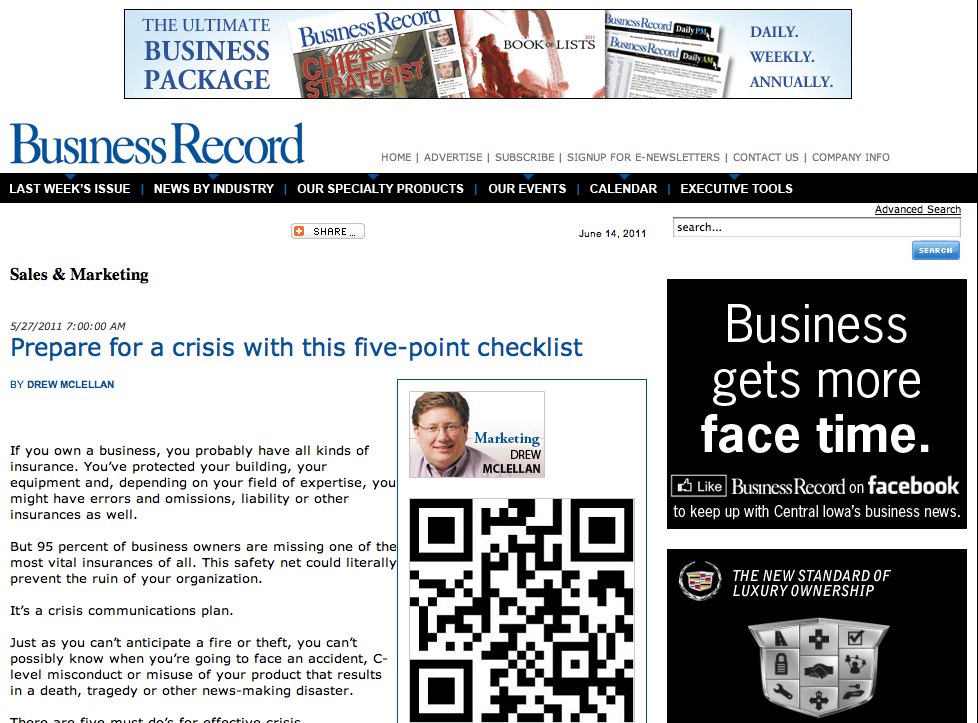
Screen shot 2011 06 14 at 11 04 38 AM
…An example of QR codes & my column

QR codes seem to be the media’s most recent marketing darling. You’ll find lots of articles talking about how to use them, including a couple I’ve written (read here and here). And in March, I shared Central Park’s incredible QR campaign to inspire you to give this technology a try.

Along with the various online places where you can find my marketing thoughts, I am a weekly columnist for Iowa’s business journal, the Business Record. A few months ago, we started adding a QR code feature to my columns — to share extra resources and to demonstrate how QR codes can work. (the screen capture is of one of my columns that has migrated from their print product to their website)

When we decided to add this feature, I decided I wanted a QR code creator that was a bit more robust than some of the free sites I’d been using. We weren’t ready for custom shapes (check out these designs) — but I did want to know how many scans each code had and if there was a pattern to when the scans were occurring.

After reviewing many options, I am down to two choices. The “must haves” for me were:

  • Could create a high resolution QR code (need it for the print publication and for some of our client’s work)
  • Reporting/tracking capabilities
  • Good customer support if we had questions

The first contender is QReate & Track by InterlinkONE. They do offer a free membership/option but I opted for the $19/month version so I could get the reporting. That reporting includes:

  • Number of scans
  • Scans by day, time and month, year etc.

Really, for most local businesses, that’s plenty unless you’re going to do some serious number crunching. In terms of easy access for support, they have a forum, a blog and you can e-mail them your question. They’re also here in the states so for me, that’s a time zone advantage.

The second contender is PushQR.com from the UK. They too offer a free option but I went for the 6.99 GBP($11 something/month) because I needed to create more than 3 campaigns a month. The big difference between the two is in the reporting. With pushqr.com, I can track:

  • Realtime # of scans
  • Bounce rate
  • Pageviews
  • Unique scans
  • Time on page
  • What barcode reader was used
  • What type of mobile device was used
  • The geography of the scanner (down to the city)

Clearly a more robust reporting menu. One of the other cool features to this site is the ability to set a goal. For example, my QR code could lead you to a landing page where I offered something for sale. The goal URL could be the thank you page that you’d go to after making a purchase. Now the reporting shows me not only how many hit the landing site and where else they went — but how many did what I wanted them to do — buy something.

As for support — they have a very simple online manual to answer the most basic of questions and I can open a ticket and submit a question/request to their team.

I haven’t quite landed on the best option for us at McLellan Marketing Group yet — but both of these providers have served our purposes for now but it’s hard to argue with PushQR’s in depth reporting and lower price.

How about you? Are you creating QR codes? How are you using them? Do you have a favorite tool?

Sphere: Related Content

Saturday, June 25, 2011

Tiny Screens


Optimizing for Mobile.

Ever hear that?

There are a couple ways to do it...

Marketers Need Mobile Sites -- But Make Them Truly Mobile
Consumers who use smartphones to shop or visit brand Web sites are time-constrained, attention-compromised, and trying to engage a brand on a tiny screen. And there are lots of them, so ignore them at your own risk.

Kari Wilson, product marketing manager, Google Mobile Ads, and Sebastien Chalmeton, vice president, mobile strategy, Phonevalley, raised those points recently at the OMMA Mobile conference in New York.

Chalmeton said that advertisers without mobile sites might as well be closed one day per week.

Wilson said 30% of people who shop for consumer electronics, 15% of finance seekers, and over 15% of insurance queries, are via mobile, but "we did a study where we looked at (the) top 1,000 advertisers and found 79% didn't have mobile optimized sites."

She said that's bad for business because 60% of consumers who have a bad mobile site experience will not go back to that site, 40% will go to a competitor's site, and 19% will have a negative perception of the brand.

Chalmeton cited five keys to creating mobilized sites. Keep the layout simple; prioritize content; use uniquely mobile features; design for thumbs not mice; and make it easy to convert consumers who have little time.

Keeping mobile sites simple "is the most critical thing you need to do when you design a mobile site," said Chalmeton, whose company has done mobile site optimization for companies like General Motors and LG.

"For Cadillac we tried to eliminate clutter as much as possible," he said. "You can view content at arms' length, and that's a rule of thumb." Also, he said, advertisers should make sure their mobile sites are focused on one piece of content at a time. "The consumer is on the go, so you can't do one-minute videos; 30 seconds is about right, because mobile sites are still slow."

Wilson said another simplification that aligns with behavior is making search easy and prominent: "For a lot of consumers, search is what they do with smartphones."

Chalmeton said one way to think about prioritizing content is to think of the three to five most important things for a mobile consumer and make those easy to find and do. Also, given the short attention span of the mobile user, he said that marketers should make mobile experiences transaction-based, not about browsing. And they should do things like using simple coding to make their mobile sites load as fast as possible, he added.

Also, Chalmeton continued, marketers need to think about what makes mobile unique, such as GPS, cameras, notepads and other utilities -- and that good mobile platforms drive consumers to retail and channel partners since the consumers are already likely to be out and about.

The final steps have to be smooth and simple, Chalmeton concluded, pointing to fairly easy mobile site features -- such as forms, click-to-call, and logins -- that can keep customers on track to purchase.

(Source: Marketing Daily, 06/07/11)

Sphere: Related Content

Saturday, June 18, 2011

Online Moms

Check out this research from Mediapost:

Brand Loyalty, Moms And The Web

Has the Internet killed brand loyalty among moms? Recent research shows that when it comes to shopping, today's consumers value research over loyalty. And since moms clearly exert the majority of influence when it comes to household purchasing decisions, it's moms -- and the very many products that they buy -- who would be impacted by such a trend. According to the report, from AMP Agency, unlike in previous generations "very few consumers between the ages of 25 and 49 are moved to purchase by habit, or sentimental considerations for a brand."

In fact, just 3% of those surveyed by that agency said they are loyal to a particular brand and never buy anything else -- very different from past generations. A key reason is that it's so easy for shoppers today to research a product before buying -- even read reviews from other people about that exact same item or service. According to the company, "with more information, consumers have seized control and are more open to the wide choices in the marketplace." Ninety-four percent of people said online research positively influenced their decision to make a purchase.

Some other findings:

  • 44% of those surveyed said they do research when buying baby products
  • 38% of the survey group said they do their research on social media sites

These findings relate to our own research, with the NPD Group, on how social media impacts moms' purchasing decisions. We found that nearly a quarter of moms who are active in social media have made a purchase for their child based on a social media recommendation.

We talked to moms after reviewing the Consumer Insights results and found that while research was crucial and influential, there was still a degree of brand loyalty, more in certain product categories than others.

Liz Thompson, a mother of four who blogs at This Full House, said that there are "brands that I grew up with and now trust with helping me to raise my family." In her case, this mostly applied to foods, clothing brands and department stores.

Yet, she continued, "I do, however, appreciate the opportunity to research new products and the ability to visit websites to see what my favorite brands are up to. For example, I look for how and where the product is manufactured, nutritional value, price comparisons, customer reviews and/or comments, along with any other information that helps me decide on whether or not to remain loyal to a particular brand."

Added Thompson, "Raising two teens and two tweens, I have researched a wide variety of products, including appliances, books, cars, cell phones, computers, educational aides, food, health and medical supplies, air and hotel rates, and vacation venues, just to name a few. I will run a general blog search on the product or service and then visit the corporate website."

Marketers: How has consumers' access to research negatively impacted your sales -- and what have you done about it?


Stephanie Azzarone is founder and president of Child's Play Communications and editor and publisher of the newsletter "Marketing Communications:Moms" and the blog "Mom Market Trends." Follow her on Twitter at ChildsPlayComm.

Sphere: Related Content

Sunday, June 12, 2011

The Net isn't Shiny

You may have heard that I am making a career change.

If not, click here for details: http://www.sclohosocialmediaadventure.com/2011/06/power-of-social-media-in-my-life.html

The company I am going to work for doesn't sell risky, shiny new toys. Here's why:

Beware of Shiny Marketing Toys

Many marketers can't resist a shiny toy. Whether pay-per-click in the mid 1990s, Web 2.0 in the early 2000s or mobile marketing in the late 2000s, we want it—and we want it now. "But at what price?" asks Laura Patterson at MarketingProfs. "I'd suggest at the price of our credibility and the opportunity to be perceived as a strategic player."

"When our enthusiasm (or that of our colleagues) convinces an organization to experiment with the next shiny toy without understanding the strategic implications," she continues, "as marketers we are doing a disservice to the organizations we support and we're presenting marketing as a primarily tactical function."

To ensure a shiny toy also makes strategic sense, be sure to ask questions like these:

  • Has our target audience adopted this new channel, or will we get there before they do? "Being first on the block may be irrelevant if the markets you serve or want to serve aren't ready," explains Patterson.
  • Does our company have the wherewithal to exploit the new channel? "If a successful implementation requires complex new skills, and if it is too time-consuming or costly to acquire that level of competence, it may be too soon for your organization to tackle the new channel."
  • Will we see a return on our investment? "The adoption of a new channel may require configuring systems, upgrading technology, or even adding new systems and training employees," she notes. In other words, you need to be reasonably sure that it's worth it.

The Po!nt: A shiny toy can quickly lose its luster if it fails to boost your bottom line—so refrain from what amount to impulse buys.

Source: MarketingProfs.

Sphere: Related Content

Friday, May 27, 2011

The Future of Radio & the Web


Automobiles have been mobile radios for decades.

More radio listening occurs in our vehicles than any other place.

We are a captive audience.

Tape players, CD players, MP players... none have made the car radio obsolete.

But now, in 2011 there are several new vehciles that offer the internet as a listening option.

The changes will take years as explained in the following interview:

Online Radio's Big Frontier: The Automobile

Study Finds That 14 Percent of Listeners Already Stream

People have been streaming radio on their computers for years, with sites such as Pandora, LastFM, AOL Radio and more drawing millions of subscribers for hundreds of stations. The next frontier for streaming radio is in cars, and in fact it's a frontier that a surprising number of people have already traversed.

A new study from knowDigital, a Lafayette Hill, Pa.-based digital media research firm, finds that 14 percent of Americans listen to streaming radio in their cars on a regular basis. What's interesting about the study is that it also concludes that streaming radio actually does not constitute a threat to traditional radio in either the short or long term. These early adopters are heavy consumers of audio media, and they listen to terrestrial stations as well as streaming ones. Also of note: In-car streamers aren't necessarily heading for Pandora when they connect. Many are using their cell phones to plug into the Internet and stream, say, their hometown radio stations, and they're doing so even when they're many miles away from home.

Sam Milkman, president at knowDigital, talks to
Media Life about the challenges to in-car radio streaming, who these early adopters are, and what this study means to media buyers and planners.

What did you find most interesting or most surprising about this study?

I guess that people are already doing this. People are already streaming in their car and the future is now.

Even though we had seen it before, it's the level at which they're doing it. Even though there are obstacles, there's really a halo over this activity, and they forgive the fact that you have to go through some hoops to get it done.

What's the most important thing media buyers and planners can take from it?

The other interesting point is that despite an endless number of choices online, when asked to program a new digital dashboard with 10 pre-sets, most streamers could only think of four or five sources they wanted to program. That includes their phone, one or two FM radio stations, their digital library and perhaps one other source.

If media planners and buyers want to find a mass audience they will need to continue to focus on the big brands in the radio space.

I'm wondering whether there's any evidence that they were using streaming to avoid commercials. Some of that is going on, but it's clear to these consumers that there are commercials in the stream.

What are the perceived difficulties to in-car radio streaming, and how are in-car streamers working around them? What's the most common way to stream (smartphone, USB port, etc.)?

First there's the connection. They're plugging [their phone] into a USB port on their dashboard, or they have a fancier Bluetooth or some accessory that is transmitting a signal to the FM receiver.

The problem then is to make [channel] choices requires that they fiddle with their telephone and use the phone's battery and data plan. They don't like that this phone is in a cup holder or seat or that they're looking down to play with it and make changes. So they're not necessarily plugging in for a short trip, which suggests to us that if a solution was there they'd use it more often.

The smartphone, probably wired to the dashboard at this point, is the most common way to stream.

Is in-car streaming more or less popular than you expected? Why?

I think that it is more popular. We thought a smaller group was doing it, but we were surprised that a good number is doing it a least a few times during the week. It suggests 14 percent of Americans are streaming at least 5 minutes per week in the car.

What sort of characteristics do in-car streamers share, beyond presumably being early adopters? Do they listen to traditional or satellite radio as well, or mostly streaming?

They definitely listen to other forms of radio. They all reported starting their drives with FM radio. The study revealed a lot of reasons why they still turn to traditional radio. There's certainly a lot of reasons why they rely upon traditional broadcasters.

Some have satellite radio -- these are people who are interested in audio media in the car in general, or just audio media in general. So it didn't surprise us a lot had satellite radio.

Also, they're commuters, they spend more time than most people in the car. They're highly interested in audio of all kinds. And beyond that they probably are looking for something different, some variety and customization, all the characteristics that apply to streamers in general.

Are there cars that stream audio without connecting to a phone or other device?

What I got out of these sessions is people don't want the car to have its own Internet connection. They want the car to pick up their phone's Internet connection, and that'll be by Bluetooth or otherwise. That's in the near future. I guess the real challenge here is how many people are going to turn over their cars and buy new ones.

How does the quality of streaming compare to traditional radio? Will this be an issue for future adoption?

They think the quality is better, that's the funny part of the whole thing. They perceive the quality to be better, and they forgive the technical limitations. So if it cuts out or buffers, they understand how often that happens and they're not bothered by it.

How much of a short-term and long-term threat to terrestrial radio is in-car streaming radio?

I think the two are compatible. They see a value in over-the-air radio and they see a value in streaming. And they seem to use the two in tandem.

Certainly in that more crowded dashboard, someone will get elbowed out. But the funny thing is, a lot of the streaming was of radio signals, it wasn't like they were turning to another source. I think in the long term the two media will learn to live together.

Over-the-air begins to adopt some principles from streaming, and streaming will incorporate elements from over-the-air, and the two come together at some point.

How long until in-car streaming becomes mainstream? What percentage of the population does it now?

I think it has to do with the cycle of car purchasing. And it's probably two generations of cars because 35-year-olds have to buy the cars that have the capabilities, and then the 18-year-olds get the used cars. So it may be as far as 14 years off.

There are certainly car radios you can buy now that will bring your phone into the dashboard via Bluetooth. And there are certainly a number of aftermarket suppliers looking to create something more than bringing the phone to an unused FM position. They want to get to a place where you can control your phone with a dashboard and not worry about messing with the phone anymore.

What are the long-term challenges to in-car streaming radio?

You know, it's the car turnover rate, and also, does the population really want more out of radio? Are they happy with what's provided to them already? To that point there have always been other sources of audio in the car -- CDs, iPods, tapes, 8-track tapes, etc., and none of those things killed radio.

This may be more interesting because it actually is radio in some ways, but in the end I think broadcasters will collect themselves and focus and meet the challenge.

There's also data plan problems and capacity problems. I heard from some that said their data plan is limited and if they stream in the car they'll rack up charges, and they don't want to do that. And there's probably a whole host of capacity issues lurking if everyone started doing this.

(Source: Diego Vasquez, Media Life, 04/28/11)

Sphere: Related Content

Saturday, April 16, 2011

Gramps is Online


Next month I'll be an official Grandpa as my youngest daughter and husband welcome their firstborn into the world.

I'm just 51. My Dad was in his 50's when he became a Grandpa too.

But today's 50 year olds are often more likely to be online and tech savy then the previous generation because we are the Boomers!

Are Digital Marketers Ignoring Baby Boomers?

Boomers' lives are going in many different directions, as empty-nesters, step-parents, grandparents and caregivers. For all of these roles, the Internet and digital media are absolutely essential.

eMarketer estimates 78.2% of this cohort is online, nearly 60 million adults. Even as their numbers decline, that penetration rate will remain high through 2015. And they control more than $2 trillion in annual spending.

"The baby boomers grew up being chased by marketers and advertisers that tailored products and brands to appeal to them," said Lisa E. Phillips, eMarketer senior analyst and author of the new report, "Digital Lives of Boomers: Reaching Them Online." "Now the median age of this cohort is 55, and many boomers feel as if they have dropped off many marketers' radar."

Boomers spend more time and money online than any other demographic. Younger boomers (ages 47 to 55) spent an average of 39.3 hours online per month in 2010, according to the Pew Internet & American Life Project. Older boomers (ages 56 to 65) averaged only slightly less, at 36.5 hours. A lot of that time was spent shopping -- and buying. Forrester Research reported that boomers spent an average of about $650 online over a three-month period in 2010, compared with $581 by Generation X internet users (ages 35 to 46) and $429 by Millennials (ages 18 to 34).

Boomers also stay connected on the go. eMarketer estimates 86.9% will have a mobile phone this year, and 16.9 million boomers will access the internet from a mobile browser or installed app. In 2015, that number will reach 25.4 million, or nearly 40% of boomer mobile users. This is a market that content providers, game publishers and brand marketers should not pass by.

Marketers who widen their messages to include boomers would be wise to make their efforts ageless, rather than targeted at an older set.

"Boomers are immediately turned off by association with old age, infirmity and decline," said Phillips. "Most brands do not want to 'age' their products with blatant appeals to older consumers. The win-win is to create an overarching brand message that gives a nod to boomers, but also includes younger adults and even grandchildren."

This often means turning a negative -- fears about failing health, for example -- into a positive, such as showing the benefits of products that contribute to a healthy lifestyle.

(Source: eMarketer, 04/04/11)

Sphere: Related Content

Wednesday, April 06, 2011

Combine the Best of Both in Retail

This is one of my favorite ways to buy online and not have to wait for delivery.

From MarketingProfs.com:

Why Customers Might Want to Pick Up Online Orders at Your Store

Barnes & Noble pioneered the concept of online orders shipped to brick-and-mortar stores for customer pickup. In Marketing by the Numbers, Leland Harden and Bob Heyman present a case study on another successful "ship-to-store" program: Ace Hardware's.

"When a customer selects ship-to-store service," they explain, "orders are fulfilled out of the warehouse for shipping to the local Ace—at no charge."

According to Ace eCommerce Marketing Supervisor, Mark Lowe, ship-to-store is a wildly popular option: online shoppers choose in-store pickups 73 percent of the time. It's not hard to see why:

  • The absence of shipping charges means substantial savings on larger items like grills and table saws, and thus lowers barrier of entry to high-priced purchases.
  • With once- or twice-weekly shipments from the warehouse, delivery times can rival those of UPS shipments sent straight to a customer's house.

Stores, meanwhile, appreciate that 33 percent of customers who pick up an online purchase also buy other items during their visits.

But before you spring a similar program on your brick-and-mortar locations, make sure they're ready: "Retailers have a lot going on in their stores every day, and this is just an additional responsibility that you're asking them to handle," says Lowe. "So [make] it as easy as possible for them to receive those orders, give it to the customer during pickup, and then, if necessary, take that return. I think it's really important that if you allow ship to store, you also allow them to return the product to the store."

The Po!nt: Customers like ship-to-store options—and a substantial number might just buy something else while they're taking delivery.

Source: Marketing by the Numbers.

Sphere: Related Content

Saturday, February 12, 2011

Starbucks & Twitter

One of the benefits of using internet based marketing programs is there usually is a lot of raw data generated for research purposes.

Brian Solis took a look at Starbucks customers from Twitter data:

The Interest Graph on Twitter is Alive: Studying Starbucks Top Followers

Posted: 08 Feb 2011 04:41 AM PST

Social media is maturing as are the people embracing its most engaging tools and networks. Perhaps most notably, is the maturation of relationships and how we are expanding our horizons when it comes to connecting to one another. What started as the social graph, the network of people we knew and connected to in social networks, is now spawning new branches that resemble how we interact in real life.

This is the era of the interest graph – the expansion and contraction of social networks around common interests and events. Interest graphs represent a potential goldmine for brands seeking insight and inspiration to design more meaningful products and services as well as new marketing campaigns that better target potential stakeholders.

While many companies are learning to listen to the conversations related to their brands and competitors, many are simply documenting activity and mentions as a reporting function and in some cases, as part of conversational workflow. However, there’s more to Twitter intelligence than tracking conversations.

We’re now looking beyond the social graph as we move into focused networks that share more than just a relationship.

Bringing the Interest Graph to Life

To demonstrate the value of interest graphs, I worked with the team at ReSearch.ly, a unique Twitter search platform that has indexed the last three years of Tweets to instantly provide a real-time and historical analysis of activity around keywords and also the people that Tweet them.

ReSearch.ly visualizes the interest graph, and also provides the ability to search within the search to sort activity by demographics and psychographics, sentiment, bio data, profession, and the list goes on. Essentially, it’s a product that anyone can use to learn about what’s really taking place on Twitter to better understand behavior and earn greater relevance by making more informed decisions.

As an example of audience profiling or competitive intelligence, we used ReSearch.ly to review the followers of @Starbucks, one of the most celebrated brands actively using Twitter today. We started by extracting 1 million follower profiles, sorted by follower count. The results were then further filtered to include only those who published a complete profile. ReSearch.ly provides the option to then organize the resulting information any number of ways, which in this case, we sorted the accounts by bio, location, and gender.

The Interest Graph

While we are what we say in our Tweets, our bios also reveal a telling side of who we really are. In this study we reviewed the complete bios of 50,000 of the top @Starbucks followers to learn a bit more about how they present their life story as well as their interests, opinions, and preferences.

Using the ReSearch.ly Twitter index, we created a word cloud to amplify the most common words used in each of the bios of these connected social consumers. Followers tended to use expressive words that suggest sentiment runs rich in the Starbucks interest graph. Top words include:

1. Love
2. Life
3. Friends
4. Music
5. World

We can also learn a bit more about Starbucks influencers by analyzing what interests them. Looking a bit deeper into the cloud, we can see that not only do emotions rise to the top; other revealing themes also surface:

1. Family
2. People
3. Mom
4. Wife
5. Husband

This is just the beginning. The words associated with the brands demonstrate the emotional and personal connections Starbucks holds with these tastemakers. Campaigns are a direct beneficiary of such data. As we submerge ourselves one level deeper into the study, we find that this information becomes paramount when we link it to individuals through demographics and psychographics. An import footnote is that the word coffee is among the least used words in the bio, but used nonetheless.

Studying Bio’graphy

With a 50,000-person sample in a traditional research survey, it may be difficult to organize individual responses. Here, we further reviewed each of the bios to find the commonalities in how each person presents who they are in a few precious characters.

Of those, we found that…

- 42 percent expressed strong ties to family, religion, and love

- 29 percent boast special interests, which is further discernible

- 22 percent are professionals who state their current place of employment and position

- 7 percent are students

Additionally, we can extract the attributes of @Starbucks followers further to better symbolize their digital persona. Further review highlights that followers…

- Identify themselves as enthusiasts, geeks, addicts, junkies, creatives

- Define the most popular areas of interest as Music, Food, Coffee, and Fashion

- Potentially favor dogs to cats (2 – 1 as per their mentions)

- Work in either Social Media and Marketing (Note: If we were to change the scale of followers, we would open up the sample to a much broader set of professions)

- Also are still studying. Despite the lower percentage, students account for more than any single professional field

Geo Location: Where in the World is @Waldo?

Brands are more than aware that no one marketing strategy reaches and moves everyone in the same way. Beyond demographic marketing, brands must also focus on driving traffic regionally. Having access to location data isn’t new, but using Twitter as a collective stream of intelligence to identify higher and underperforming locales and associative word clouds allow teams to surface the 3 W’s of real-time geo loco marketing:

Where is negative/positive activity taking place?

Why is it leaning in that direction? And,

What can we do about it?

To give us an idea of where the top @Starbucks followers are Tweeting, we zoomed in to their point of reference. We found that top users tend to Tweet from…

1. California
2. New York
3. Texas
4. Florida
5. Washington

Combining London and UK, we find that The United Kingdom would actually join the ranks of the most often cited cities.

Grouping locations provides a holistic view that provides regional marketing metrics and also areas in need of attention.

Here we can see that the top Tweeps are located in…

- US East, 30 percent
- Non US, 27 percent
- US West, 22 percent
- US Midwest, 21 percent

Tweeting from the Gender Lines

Over the years, I’ve studied the gender makeup of social networks and have consistently found that women outnumber men in some of the most popular networks including Twitter and Facebook. On Twitter, women represent the majority share with 57 percent.

Working with the team here at PeopleBrowsr and ReSearch.ly in conjunction with Klout earlier in 2010, we uncovered en masse, women are more influential than men on Twitter. In fact, the average Klout score within the general Twitter population 34 to 31 in favor of women.

Reviewing Starbucks top followers in ReSearch.ly, it comes as no surprise to see that the women are the predominant source of Tweets, 63 percent women vs. 37 percent men.

The Tweets Have It!: Introducing the Starbucks Brand Graph

The interest graph is defined by connections, but it is brought to life through self-expression. When we combine brand-centric relationships and conversations, the interest graph eventually evolves into what is essentially a brand graph. Within each brand-related graph is a group of highly connected individuals that serve as a company’s network of influence. The ReSearch.ly team extracted 50,000 of the most recent Tweets that included a mention of Starbucks. We then analyzed the connections between people and identified the top 100 individuals and the number of their followers who also mention Starbucks within the 50,000 mentions. We can then bring to light Starbucks influencers as a representation of its brand graph and influential hubs. As we can see, the difference between monitoring and gathering intelligence allows Starbucks to now identify relevant networks and introduce personalized campaigns to further spur advocacy and loyalty.

Here are the top 100 most connected people within the group mentioning Starbucks and the number of their followers also discussing Starbucks:

Accordingly, we can visualize the interest graph as connections, showing how influencers are not only interconnected, but also capable of disseminating relevant information and influencing behavior to varying degrees beyond the traditional reach of Starbucks. Social consumers and their place within the social consumer hierarchy determine reach and ultimately outcomes. Everything begins however, with recognizing who they are and what inspires or motivates them.

Conclusion

The era of analysis paralysis is officially over. Instead of just listening, companies can now study people and their interests based on what they say and do and also how they color their profiles. This goldmine of insight gives brands the potential to improve marketing, promotional and advertising campaigns to start. What we’re talking about here is the ability to personalize experiences that go beyond demographics and start to employ psychographics and behaviorgraphics – the ability to connect with groups of people by interest and how they interact.

As this practice develops, brands can also gather the intelligence necessary, and widely available, to improve products, services, and spark new waves of tweets gushing with positive sentiment. Doing so over time helps to build the social, and more relevant, business of the future while improving relationships to convert followers into stakeholders.

Brian Solis is the Chief Data Analyst at PeopleBrowsr and ReSearch.ly and author of Engage, the complete guide for businesses to build and measure success in the social web. Follow him on Twitter, @briansolis or read his blog, BrianSolis.com

Sphere: Related Content

Sunday, February 06, 2011

Super Bowl, Super Fans, Super Web Users?


It starts in a few hours. I'll be watching, will you?

Sports and Leisure: How Web Savvy Are Super Bowl Fans?

Super Bowl advertisers take note. A new study by The Media Audit reveals that 41.6% of U.S. adults who regularly follow the Super Bowl on TV or radio are also considered heavy Internet users, spending three or more hours in the typical day online. Furthermore, Super Bowl fans are more likely than the general population to surf popular websites and make online purchases.

According to the national study, 71% of those who regularly follow the Super Bowl have made one or more online purchase in the last year, compared to 64.6% for the general population. Furthermore, 47.5% have made five or more purchases within the past year and 26.7% have made at least twelve purchases in the past year.

The same study reveals that Super Bowl fans are more likely to visit the web pages of newspapers, TV stations, and radio stations. Among Super Bowl fans, 41.7% have made a visit in the past month to a TV network website, compared to 36.5% of the general population. As a result, Super Bowl fans are 16% more likely to visit a TV network's website. Super Bowl fans are also 16% more likely to have visited a radio station's website in the past month and 17% more likely to have visited the website of a major daily newspaper.

One in four Super Bowl fans regularly or occasionally visit an automobile website, compared to 21.9% for the general population. Among some of the more popular automotive specific websites visited are Autotrader.com and Craigslist.org. Six percent of Super Bowl fans have visited Autotrader.com in the past month, a figure that is 30% higher when compared to the general population, and 7.9% have visited Craigslist.org for automobiles, a figure that is 10% higher when compared to the general population.

(Source: The Media Audit, 01/31/11)

Sphere: Related Content

Monday, January 31, 2011

Smart Phone Revolution

I've been meaning to create a Droid app for my sites.... Here's why.

From Drew:

Marketing tip #4: Better pay attention to mobile

by Drew McLellan

About 12 months ago, people thought I was crazy for launching the Drew McLellan app for both the iPhone and the Droid (download it for free by clicking on the link in the sidebar) but I was just jumping on a trend's tsunami of a wave -- all to get my ideas and recommendations out to you.

If you prefer to access information with your smart phone, I want to be there too. It's that simple. Is your company thinking along the same lines?

The trend's wave, if anything, is getting larger. The usage numbers are staggering and I think we're at the tip of the iceberg here. Watch this short video and imagine the numbers in 2 or 5 years. (e-mail subscribers, click here to view the video


If you haven't asked yourself and your team these questions -- you'd better get to it:

  1. How are we going to reach our customers, prospects and/or employees via mobile?
  2. How quickly can we get started?
  3. Are our competitors already using mobile? How far behind are we?
  4. If we'd be first -- how far ahead would we be?

Experts predict that by 2020, most of us will be using our mobile device as our primary tool for accessing the web.

Will you be on board with mobile by then?

Sphere: Related Content

Sunday, January 16, 2011

79% of Americans do this...


...Go online.

Lot's of info about Generational use of the internet in this report from Mediapost:

Generational Disparities in Internet Use

A new Pew Research study notes that there are still notable differences by generation in online activities, but the dominance of the Millennial generation that was documented in the first "Generations" report in 2009 has slipped in many activities.

This is the second report by the Pew Research Center's Internet & American Life Project exploring how different generations use the internet. All the generation labels used in these reports, with the exceptions of "Younger Boomers" and "Older Boomers," are the names conventionalized by William Strauss and Neil Howe in their book, Generations: The History of America's Future. The Pew Project "Generations reports" makes the distinction between younger and older Boomers, but Pew separated Younger Boomers and Older Boomers here because enough research has been done to suggest that the two decades are distinct generational groups.

Generations

Generation name

Birth years, Ages in 2010

% of total adult population

% of internet-using population

Millennials

Born 1977-1992, Ages 18-33

30%

35%

Gen X

Born 1965-1976, Ages 34-45

19

21

Younger Boomers

Born 1955-1964, Ages 46-55

20

20

Older Boomers

Born 1946-1954, Ages 56-64

14

13

Silent Generation

Born 1937-1945, Ages 65-73

7

5

G.I. Generation

Born -1936, Age 74+

9

3

Source: Pew Research, December 2010

Milliennials, those ages 18-33, remain more likely to access the internet wirelessly with a laptop or mobile phone. In addition, they still clearly surpass their elders online when it comes to:

  • Use of social networking sites
  • Use of instant messaging
  • Using online classifieds
  • Listening to music
  • Playing online games
  • Reading blogs
  • Participating in virtual worlds

However, internet users in Gen X (those ages 34-45) and older cohorts are more likely than Millennials to engage in several online activities, including visiting government websites and getting financial information online.

Among the major trends in online activities:

  • While the youngest generations are still significantly more likely to use social network sites, the fastest growth has come from internet users 74 and older: social network site usage for this oldest cohort has quadrupled since 2008, from 4% to 16%.
  • The percentage of all adult internet users who watch video online jumped 14 points in the past two years, from 52% in May 2008 to 66% in May 2010.
  • 51% of all online adults listen to music online, compared with 34% the last time this question was asked, in June 2004. While Millennials used to be by far the most avid listeners, Gen Xers and Younger Boomers are catching up.
  • As of May 2010, 53% of online adults have used a classified ads website such as Craigstlist, up from 32% in September 2007.
  • Additionally, searching for health information, an activity that was once the primary domain of older adults, is now the third most popular online activity for all internet users 18 and older.

Generations Online

Generation

Age Group

% Who Go Online

Millennials

Ages 18-33

95%

Gen X

Ages 34-45

86

Younger Boomers

Ages 46-55

81

Older Boomers

Ages 56-64

76

Silent Generation

Ages 65-73

58

G.I. Generation

Age 74+

30

All online adults

Age 18+

79

Source: Pew Research, December 2010

Seventy-nine percent of all American adults go online, a number that has remained relatively steady since early 2006. While most generations have internet adoption rates of at least 70%, internet use drops off significantly for adults over age 65: only 58% the Silent Generation and 30% of the G.I. Generation go online. As a result, younger generations continue to be over-represented in the online population, with adults ages 45 and younger constituting about 56% of the online population, despite making up only 49% of the total adult population. The Millennial generation is particularly prominent online

Generations Online Vs. Generations Offline (% Of U.S. Adult Population)

Millennials

Gen X

Younger Boomers

Older Boomers

Silent Generation

G.I. Generation (74+)

Overall pop

30

19

20

14

7

9

Online pop

35

21

30

13

5

3

Source: Pew Research, December 2010

31% of non-internet users say that the main reason they do not go online is that they are simply not interested in doing so. 12% cite not having a computer, and 10% say that it would be too expensive.

Main Reasons For Not Using The Internet

Reason

% of Respondents

All offline adults Age 18+ % who do not use the internet

21%

Just not interested

31

Don't have a computer

12

Too expensive

10

Too difficult

9

It's a waste of time

7

Don't have a access

6

Don't have time to learn

6

Too old to learn

4

Don't want/need it

4

Just don't know how

2

Physically unable

2

Worried about viruses/spyware/spam

1

Other

5

Source: Pew Research, December 2010

Online Activities (% of Generation Group)

% Engaging

Activity

Teens

Millennials

Gen X

Younger Boomers

Older Boomers

Silent Gen.

G.I. Gen.

All adults Age 18+

Go online

93%

95%

86%

81%

76%

58%

30%

79%

Teens and/or Millennials are more likely to engage in the following activities compared with older users

Watch a video

57

80

66

62

55

44

20

66

Use social network sites

73

83

62

50

43

34

16

61

Send IMs

67

66

52

35

30

29

4

47

Play online games

78

50

38

26

28

25

18

35

Read blogs

49

43

34

27

25

23

15

32

Visit a virtual world

8

4

4

4

3

3

1

4

Activities where Gen X users or older generations dominate

Visit a government website

*

61

75

73

69

56

41

67

Get financial info

*

33

38

41

41

44

30

38

For some activities, the youngest and oldest cohorts may differ, but there is less variation overall

Send or read e-mail

73

96

94

91

93

90

88

94

Use a search engine

*

92

87

86

87

82

72

87

Look for health info

31

85

84

84

85

76

59

83

Get news

62

76

79

76

76

67

54

75

Buy a product

48

68

66

64

69

59

57

66

Make travel reservations

*

64

67

70

67

61

53

66

Bank online

*

62

62

58

56

44

35

58

Use online classifieds

*

64

58

49

42

30

17

53

Listen to music online

*

65

58

48

38

25

12

51

Look for religious info

*

31

35

34

33

26

28

32

Rate a product, service or person

*

32

32

29

40

38

16

32

Participate in an auction

*

28

31

25

25

13

7

26

Make a charitable donation

*

21

24

24

23

20

13

22

Download podcasts

*

26

20

20

16

12

10

21

Work on own blog

14

18

16

11

11

8

5

14

Source: Pew Research, December 2010

Editor's Note:

This is a very complete and complex report and, if the subject is relevant to you, I urge readers to pursue the entire text summary and PDF file for additional clarification and information.

Sphere: Related Content