Showing posts with label magazine. Show all posts

Sunday, July 03, 2011

QR Code Ideas

A couple months ago I received an issue of Fast Company magazine and decided to look for QR Codes.

I was surprised at how few there were, and even more surprised at what happened when I scanned them with my phone.

6 QR codes.

3 went to the companies regular website which was not mobile optimized.

1 went to a mobile version of a company website.

1 went to a special web page that was tied to the ad.

1 would not scan at all.

Only 1 out of 6 QR codes were worth scanning, and considering that less than 10% of the ads had a QR code means either:

  1. QR Codes are cutting edge and something that early adopters will latch onto and eventually become mainstream.....
  2. QR Codes will die off because no one knows what to do with them or how to make them relevant.
I hope it's #1.

Drew offers some ideas:

Creating smart QR Codes


Screen shot 2011 06 14 at 11 04 38 AM
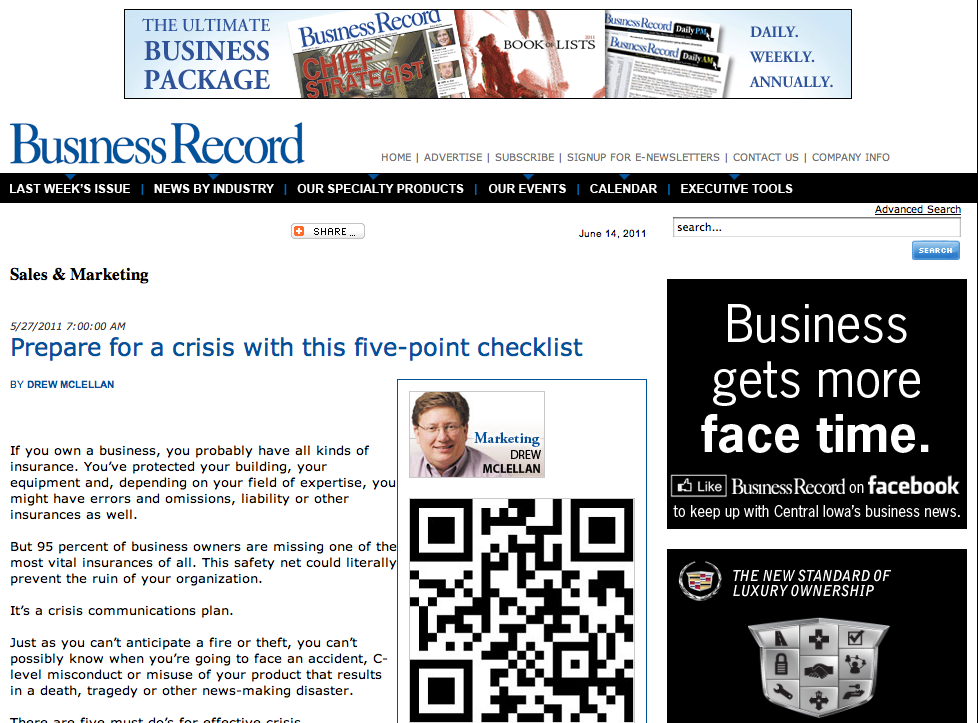
…An example of QR codes & my column

QR codes seem to be the media’s most recent marketing darling. You’ll find lots of articles talking about how to use them, including a couple I’ve written (read here and here). And in March, I shared Central Park’s incredible QR campaign to inspire you to give this technology a try.

Along with the various online places where you can find my marketing thoughts, I am a weekly columnist for Iowa’s business journal, the Business Record. A few months ago, we started adding a QR code feature to my columns — to share extra resources and to demonstrate how QR codes can work. (the screen capture is of one of my columns that has migrated from their print product to their website)

When we decided to add this feature, I decided I wanted a QR code creator that was a bit more robust than some of the free sites I’d been using. We weren’t ready for custom shapes (check out these designs) — but I did want to know how many scans each code had and if there was a pattern to when the scans were occurring.

After reviewing many options, I am down to two choices. The “must haves” for me were:

  • Could create a high resolution QR code (need it for the print publication and for some of our client’s work)
  • Reporting/tracking capabilities
  • Good customer support if we had questions

The first contender is QReate & Track by InterlinkONE. They do offer a free membership/option but I opted for the $19/month version so I could get the reporting. That reporting includes:

  • Number of scans
  • Scans by day, time and month, year etc.

Really, for most local businesses, that’s plenty unless you’re going to do some serious number crunching. In terms of easy access for support, they have a forum, a blog and you can e-mail them your question. They’re also here in the states so for me, that’s a time zone advantage.

The second contender is PushQR.com from the UK. They too offer a free option but I went for the 6.99 GBP($11 something/month) because I needed to create more than 3 campaigns a month. The big difference between the two is in the reporting. With pushqr.com, I can track:

  • Realtime # of scans
  • Bounce rate
  • Pageviews
  • Unique scans
  • Time on page
  • What barcode reader was used
  • What type of mobile device was used
  • The geography of the scanner (down to the city)

Clearly a more robust reporting menu. One of the other cool features to this site is the ability to set a goal. For example, my QR code could lead you to a landing page where I offered something for sale. The goal URL could be the thank you page that you’d go to after making a purchase. Now the reporting shows me not only how many hit the landing site and where else they went — but how many did what I wanted them to do — buy something.

As for support — they have a very simple online manual to answer the most basic of questions and I can open a ticket and submit a question/request to their team.

I haven’t quite landed on the best option for us at McLellan Marketing Group yet — but both of these providers have served our purposes for now but it’s hard to argue with PushQR’s in depth reporting and lower price.

How about you? Are you creating QR codes? How are you using them? Do you have a favorite tool?

Sphere: Related Content

Tuesday, February 23, 2010

Not Just a Clown Anymore

McDonald's is a client of mine via the radio stations I work for. I have frequent contact with the local owner/operators and the agencies that handle their advertising and p.r. for our section of the state of Indiana.

Here's an inside look from Time magazine on what's cooking at the home of Ronald McDonald:


McDonald's Chef: The Most Influential Cook in America?

Correction Appended: Feb. 12, 2010

On some level, the very idea of a McDonald's chef sounds preposterous. Burgers, fries, the McRib — is this really the work of a chef? The food at McDonald's tastes partly of nostalgia and partly of marketing; the rest is surely salt.

And yet — have you eaten at a McDonald's lately? In the past five years, the company has started to serve genuinely edible salads, unlike those dry iceberg-and-carrot things it used to offer. The Southwest Salad, which appeared in 2007, comes with a lime wedge and a credible corn salsa. Similarly, the new Angus Third Pounders — a line of relatively expensive and meaty hamburgers that have 66% more beef than a Big Mac and less bread — are just as tasty as the triple-the-price burgers at T.G.I. Friday's.

I'm not the only one who thinks so. After all the bad press in the early '00s — the company has been blamed, with some justification, for the global rise in obesity — McDonald's is enjoying a heady resurgence. Each day, it feeds some 26 million Americans, 2 million more than it did in 2006. In the past five years, the McDonald's Corp. share price has jumped from below $30 to above $60. (See the 10 worst fast food meals.)

McDonald's has doubtless benefited from the weak economy — its low-cost, seemingly healthy Snack Wraps (soft tortillas filled with chicken, lettuce and cheese) are perfectly positioned to feed a nation simultaneously worried about money and fat — but the company's boom actually began in 2006, before the recession hit. A major reason was the improvement in its menu. A glowing Feb. 2 Goldman Sachs analyst's report on McDonald's is typical of Wall Street sentiments. The report says McDonald's is "stepping up investment when peers cannot" and cites the "strong new product pipeline" as a key factor.

It turns out there's a chef at the beginning of that pipeline — a cook who trained at the Culinary Institute of America and who once ran the gracious kitchens at the Four Seasons Resort and Club outside Dallas. The Southwest Salad, the Angus burgers, the Snack Wrap — they all emerged from the food laboratory of Daniel Coudreaut, 44, whose business card reads DIRECTOR OF CULINARY INNOVATION, MENU MANAGEMENT but who likes to go by Chef Dan. (See the top 10 bad beverage ideas.)

In a move that could be the New Coke of Coudreaut's career, his kitchen has created the Mac Snack Wrap, or Mac Wrap for short. The Mac Wrap is the first new version of the Big Mac the company has introduced since the iconic burger was launched in the 1960s. The Big Mac remains on the menu — the company isn't stupid — but executives were so fearful of spinning off a variant that internal negotiations and testing took a year. "Don't touch" was the attitude toward the Big Mac when he arrived, says Coudreaut. The fact that the top brass allowed him to remix it is both an expression of the company's faith in him and a signal that McDonald's once again feels strong enough to take risks. (See pictures of what makes you eat more food.)

The rollout for the Mac Wrap began quietly in December, but by last month, when it became the subject of a major ad campaign, the Mac Wrap was in all 14,000 U.S. McDonald's. For all that, it is a strange, simple little invention. To make a Mac Wrap, you take about half the interior of a Big Mac — a single beef patty, three quick squeezes of special sauce, less lettuce, less cheese, fewer pickles, fewer onions — and wrap the software in a tortilla instead of stacking it on a sesame-seed bun. McDonald's serves the Mac Wrap for only $1.50; it has just 330 calories, 210 fewer than the Big Mac. The wrap offers a familiar taste without the guilt, but that's not to say it's good for you. More than half its calories come from fat, and a single Mac Wrap has 690 mg of sodium — almost as much as in an entire Quarter Pounder (730 mg). One Mac Wrap contains 46% of your recommended daily allowance of salt. (Comment on this story)

Public-health advocates will surely assail the company for creating the wrap, partly because you have to eat two to feel full (at which point you would have been better off ordering one Big Mac). But I wanted to know about the man behind it, this guy who thinks he can tinker with a paragon of Americana as durable as the Big Mac. Coudreaut might call himself Chef Dan, but isn't he just a p.r. stunt, a suit masquerading in chef's whites?

See the top 10 food trends of 2008.

See the best and worst Super Bowl commercials of 2010.

The Secrets of Celery Root
The youngest of five, Coudreaut grew up in Ossining, N.Y., not far from New York City. From around age 7, he was his mom's helper at mealtimes and kept a written inventory of ingredients in the pantry. At 14, he got a job washing dishes at a diner where the chef-owner let him look over his shoulder at the stoves. For a while, Coudreaut thought he might want to be in show business, and as a kid he got small roles in TV commercials and an off-Broadway play. He also went to business school, but all the while he kept cooking, and at 28, he enrolled at the Culinary Institute.

In 2004, Coudreaut arrived at McDonald's headquarters, a sprawling, bosky campus in Oak Brook, Ill., outside Chicago. His kitchen, which is on the third floor of the main building, is the sort you would see in the back of house at an expense-account restaurant. It features granite countertops (requested by Coudreaut), a giant Wolf range that cost more than most McDonald's employees make in half a year, and a salamander, a device that professional kitchens use to brown food before serving. (See more about McDonald's.)

On the day I visited, Coudreaut was experimenting with some very non-McDonald's ingredients: celery root, broccoli rabe, wild salmon, hazelnuts, candied orange rind. There was a huge pot of veal stock simmering on a back burner of the Wolf. He seemed to want to prove his culinary skills, and he did — he made a delicious lunch — but what does any of this have to do with creating food at a real McDonald's?

The answer is that every great manufacturing company runs a crazy R&D department, a place where mad scientists get to fiddle with toys and produce one or two breakthroughs a year. Coudreaut and his staff of 16 consider approximately 1,800 ideas for new menu items each year, but only a couple — or in an atypical year, as many as five — make it onto the menu. Few stay permanently.

Coudreaut and his team spend most of their time playing with ingredients far more practical than broccoli rabe and celery root. Most days, they work with chicken and apples and beef. Facing the kitchen through a glass wall is a large sign reading IT'S NOT REAL UNTIL IT'S REAL IN THE RESTAURANTS. (See the best business deals of 2009.)

That's a highly corporate way to think about food — celery root is certainly real, so real that it's covered in dirt when you buy it at the supermarket — but McDonald's is, after all, a corporation. Coudreaut may be a chef, but his employer is no restaurant. McDonald's Corp. is largely a holding company, a middleman that works between restaurant owners and food suppliers. It provides franchisees with inexpensive, processed ingredients and — this is where Coudreaut's team and other development people come in — a guarantee that new menu items have been tested and tweaked and retested so they can come out looking and tasting roughly the same in every McDonald's in every part of America. (Teams led by other chefs work on other continents; that's why McDonald's has used rice patties as burger buns in Hong Kong and Taiwan and now offers a whole-shrimp sandwich on a steamed bun in Japan.)

And anyway, there is literally not enough celery root grown in the world for it to survive on the menu at McDonald's — although the company could change that, since its menu decisions quickly become global agricultural concerns. Not long after he arrived at McDonald's in 2004, Coudreaut added to the menu an Asian salad that included edamame. The Soyfoods Council, a trade group, immediately got calls from consumers across the nation looking to buy edamame at their grocery stores. "Now you can find it in supermarkets all over," says the council's executive director, Linda Funk, who has even seen the immature soybean pods sold near her small hometown of Janesville, Wis.

Nothing gets on the menu at McDonald's without the approval of hundreds of people: marketers, franchise representatives, engineers who specialize in food hold times, operations managers who know precisely how far refrigerated trucks can drive before food rots and money people who have read reams of market research that has relentlessly focus-grouped every ingredient combination that could be part of a Snack Wrap.

See a special report on the science of appetite.

See the top 10 tasteless commercials.

The franchisees are a particularly important constituency, since they pay for the equipment to produce any new menu item. They often have ideas for Coudreaut's team to appraise — the Angus burgers were co-developed with a group of California franchisees — and they often push back against odd-sounding creations like one of Coudreaut's failures, a breakfast Snack Wrap made with a crepe that held vanilla cream cheese and fruit. ("Why it didn't work is because we served it cold," Coudreaut says. "We serve hot food. Even our salads, we serve warm chicken on top.") The testing process is painstaking: it took two years for the Angus Third Pounders, the company's first new burger in eight years, to get on the menu.

When I visited his kitchen, Coudreaut made an exquisite endive and poached-pear salad with dried cherries and mustard-seed dressing. Say he wanted to put that salad on the menu. Among his first steps would be to go to the produce experts at McDonald's and ask about endive. He imagined the answer he would get: "Well, Dan, you're gonna have to get somebody to grow it. And that's not hard to do, but it's gonna take three years." (See 10 myths about dieting.)

So then Coudreaut might consider mixing the endive with more commercially available lettuces, a step that would reduce the lead time. What about the mustard-seed dressing? You could do that even faster, plus it's a "great flavor combination with the cherries," he said. Except there's a problem with cherries: you can never guarantee that all the pits are out. Imagine the lawsuit from the guy who breaks a tooth on a pit. So you end up with only the pears. They are widely available and have a great shelf life. Coudreaut poached the pears he served to me in gewürztraminer. McDonald's could never do that for its outlets, but what if you softened pear slices in a poaching liquid other than wine — a step that would both enhance flavor and extend hold time? "Why couldn't we do a signature poached pear?" Coudreaut asked, getting very excited.

At just this point in our conversation, the McDonald's p.r. executive who was with us — an elegant British woman named Danya Proud — coughed rather loudly. Coudreaut trailed off. R&D is secret at every company. (See nine kid foods to avoid.)

Building a Better Big Mac
Of course, this is still McDonald's, which means Coudreaut's food must eventually be so simple that a high school dropout can make it. And so, culinarily speaking, McDonald's moves in baby steps. Before Coudreaut, the company had never asked its cooks to brush a glaze onto a chicken breast before setting it on a salad. Now glazing the chicken is standard, which is one reason the salads taste so much better.

Coudreaut's quest to improve on time-honored formulas is what led him to the Mac Wrap, a product that will be a good experiment in whether the eating habits of McDonald's customers can be nudged in new directions. Coudreaut's immediate boss, vice president of menu management Wade Thoma, had to push hard inside the Oak Brook headquarters to sell the idea that the Mac Wrap is, in Coudreaut's words, "how people are eating today — on the go, in smaller portion sizes." Smaller doesn't necessarily mean healthier, though. McDonald's is acutely aware of the criticisms about the food it has sold for the past half-century, but in the end, it also knows that very few McDonald's customers have read Fast Food Nation, a scathing indictment of the industry, or seen the 2003 documentary Super Size Me, in which a filmmaker ate only McDonald's for a month and — shockingly — got fat. Instead, McDonald's has learned to focus on balance: you add a healthy Southwest Salad, and then you add a rich Angus burger. Also, you don't mess with the fries. Coudreaut could never mess with the fries.

Still, it's nice to know McDonald's employs a dreamer. In addition to that endive salad, Coudreaut sautéed a very simple wild-salmon fillet for me — just salmon seasoned with salt and pepper and cooked in olive oil. Four ingredients. I asked why four ingredients couldn't work at McDonald's. Coudreaut thought for a moment and gave a half nod, half shrug. "Maybe five years from now," he said.

The original version of this article misstated that McDonald's has used rice patties as burger buns in China. It was in Hong Kong and Taiwan.

Sphere: Related Content

Sunday, January 18, 2009

The Death of or by Procrastination

You may not call it procrastination, maybe you are simply following tradition. A tradition that is cautious, measured, and s-l-o-w.

A few years ago a friend of mine was going to launch a magazine focused on local family and women. I saw the mock ups, a couple sample stories, and then 6 weeks later saw a very similar publication at the news stand. She was about 6 months from launch, and 8 months too late.

We need to either kill procrastination or by killed by it. Drew wrote about this:

The Marketing Minute


Do we have to over think everything?

Posted: 16 Jan 2009 11:25 AM CST

32139473 I spent several hours on a recent Saturday with a 25 year old entrepreneur. What struck me the most about him was how quickly and nimbly he moved from idea to action.

I'm not talking huge actions -- but test the water actions.

I think many companies suffer from "Overthinkitis." By the time they have vetted, committeed and white papered an idea...it's not new anymore. In fact, someone else launched it 6 months ago.

One of the biggest benefits of the digital world is that we can leap from idea to action quickly and often -- inexpensively. We don't have to vet it in a boardroom -- we can vet it in the market.

I'm challenging myself and you -- let 2009 be the year that you move from thought to action faster and with more of a "lab experiment" mentality. Don't wait until it's perfect. Stop thinking...start doing. And start doing -- faster.

John Moore at Brand Autopsy has an annual tradition. On New Year's eve, he posts Bruce Mau's Incomplete Manifesto for Change. Bruce is a remarkable design consultant who first crafted his manifesto in 1998. Bruce's manifesto captures the spirit of this idea far better than I could.

Please take time to read it. Better yet -- take time to do it.

What's one idea you want to quickly take to action? Could you do it in 10 days? Tomorrow?

Sphere: Related Content

Monday, January 12, 2009

How to Increase Magazine Circulation


Here's a creative way to get the magazine into more hands and sell some ads:

'Men's Vogue' To Piggy-Back on 'Vogue' WWD Condé Nast has found a way to keep Men's Vogue alive after shrinking the title to twice a year. The spring issue will appear as a reverse-bound issue attached to the April issue of Vogue. It will be the first time Vogue has published a reverse cover. This special Men's Vogue will likely carry around 60 pages. A four-color full-page ad will cost $52,340, compared to a similar ad in Vogue for $128,220. The experiment helps the publisher in two ways. Men's Vogue more than doubles its circulation, which was 350,000 as a monthly title, by being sent to Vogue's 800,000 plus subscribers. Also, Vogue gets a boost in ad pages from having Men's Vogue in its issue. Company execs say that if the double-magazine effort works, it might be used to revive another fledgling Vogue spinoff, Vogue Living. - Read the whole story...

Sphere: Related Content

Saturday, January 10, 2009

Print News


Mediapost sent me these clickable stories about the print business:

by Erik Sass
The Boston Globe will start selling front-page ads during the first quarter of this year. The Chicago Tribune is reversing course, pulling many of the most prominent features of the redesign ordered last year by the Tribune Co.'s new management ... Read the whole story
by Erik Sass
The real estate downturn and general recession have claimed another victim in the beleaguered shelter category: Country Home, which Meredith Corp. is shuttering after its March 2009 issue. ... Read the whole story

Sphere: Related Content

Friday, January 02, 2009

Selling Cars on the Radio


After seeing this research, I wonder if the radio industry could have saved the car companies? At least they should pay attention to it now:

Possible Automotive Media Rethink

According to a recent analysis of BIGresearch's SIMM database by Prosper Technologies, wide gaps exist between how ad dollars have been spent versus what consumers say works best when it comes to buying a car. The Prosper analysis and media allocation model utilizes the SIMM Survey of 17,231 consumers to determine "what" and "which" media forms are most influential to consumers for buying a car, the consumption of the media, and pricing of various measured media.

Changes demanded by Congress and proposed by the automakers should include a reallocation of advertising dollars, says the BIGresearch summary. The study analysis apparently considers a disproportionate allocation of spending on TV versus other media out of balance with consumer actions.

And, combined with consumer analytics from the SIMM Survey, the report concludes that the amount of radio consumed, its influence to purchase, combined with lower costs makes it a stronger media option for automakers, which, according to consumers, is under-utilized.

The cross platform, consumer-centric media planning and allocation tool presents a modeled media allocation against the actual ad spending characteristics in the selected data.

?Automotive Ad Spend vs. Prosper Media Allocation Model (% of Total U.S. Advertising Spend in 2007)


General Motors Spend Share

Ford Spend Share

Chrysler Spend Share

Prosper Allocation Model

Magazines

12.4%

11.9%

10.5%

15.6%

Newspaper

5.0%

5.2%

6.9%

6.2%

Outdoor

1.5%

0.7%

0.5%

14.6%

TV

39.1%

38.9%

43.2%

17.3%

Radio

3.5%

2.3%

1.9%

21.5%

Internet

7.0%

6.5%

3.0%

8.5%

Other

31.5%

34.5%

34.0%

16.3%

Source: Ad Age Domestic Ad Spending by Category (2007)/Measured media from TNS Media Intelligence's Strategy, Prosper Media Allocation Model

Allocation Model: Media influence weighted by consumption and media cost for people planning to buy/lease a car/truck in the ensuing 6 months

For charts specific to GM, Ford and Chrysler please visit BIGresearch here.

Sphere: Related Content

Monday, December 15, 2008

Does Print Need a Bailout?


As certain industries are feeling a financial pinch, namely, the mortgage and credit industries including banks; automotive; and retail; the trickle down effect is felt in the advertising mediums that relied on those sectors for advertising revenue.

But it wasn't just the recession that caused the hurt. It was changes in consumer behavior that began when we were rolling in the dough.

Print publications are dropping like flies. Many are scrambling to try and make money and reorganize to stay alive. What has caused this? Basically the internet.

No, we won't see a bailout of the newspaper or magazine industry, or any other advertising medium. We'll see changes accelerate in the next 12 months as the old media restructures and the new business model emerges. This story shows what is going on in the magazine industry:


2008: Magazines Ad Sales Plummet

As if there isn't enough bad news, 2008 has turned out to be the worst year in decades for magazines, as measured by total ad pages. Through the middle of December, consumer magazines are down 9.4% from last year, according to MIN Online; this compares with a 7.8% drop in 2001. Worse, magazines do not appear to be headed for a quick rebound like the last recession.

At this rate, 2008's losses will almost certainly be compounded in 2009--bringing two straight years of declines, which will result in more magazine closures and layoffs.

chart

Monthly magazines have seen ad pages tumble by double-digit percentages in the final two quarters, according to MIN Online, and the trend is clearly accelerating. On a quarterly basis, year-over-year declines have steadily deepened from -4.6% in the first quarter to -6.1% in the second, to -11.5% in the third, and finally -13.9% in the fourth. In the last six months, the rate of year-over-year decline has increased from -11.3% in July to -17.7% in December.

Much of this decline can be attributed to the recession, which officially began a year ago, according to a recent analysis by the National Bureau of Economic Research. However, the decline is more troubling in light of recent historical context: 2006 and 2007 were also slow years, with an average year-over-year growth rate of just 1.25% per quarter.

This was a period when the economy was supposedly healthy, suggesting that magazines were already under attack from Internet advertising and other new media. Now that the two trends are coinciding, with secular media shifts reinforced by the economic downturn, there is no telling where the bottom is, or if there is one.

Among the weeklies, the biggest year-to-date losers in terms of ad pages include: U.S. News and World Report (31.2%), Time (26%), Newsweek(21.7%), The New Yorker (21.5%), Entertainment Weekly (18.7%), Life & Style Weekly (18.2%), BusinessWeek (18%). Among biweeklies, they are: Country Weekly (23.6%), Rolling Stone (23%), ESPN (18.5%) and Forbes (16.8%).

Monthlies are also hurting. The biggest year-to-date losers are: More (30.1%), Smart Money (29.6%), Blender (29%), Gourmet (23.7%), Fitness (22.6%), Cooking Light (21.3%), Ladies' Home Journal (20.3%), Real Simple (18.4%), Better Homes and Gardens (17.6%), Vanity Fair (15.3%), Southern Living (15.2%), In Style (14.8%), Esquire (14.5%), Family Circle (13.7%), O, the Oprah Magazine (13.7%), Prevention (12.5%), Glamour (12.4%), Motor Trend (11.7%), GQ (11.5%), Lucky (11.3%) and Martha Stewart Living (11.2%).

Sphere: Related Content

Tuesday, November 25, 2008

Good News for the Magazine Industry

Several Publications have been cutting issues or eliminating the paper product entirely in favor of an on-line only business model.

Here's news of a new publication that should do just fine:

Reader’s Digest to Launch Magazine, Facebook for Christians

RDA strikes deal with pastor to produce ‘inspirational multimedia platform.’

RELATED: Reader's Digest Considering Name Change [0]

Calling it nothing less than one of the company's “most important and far-reaching ventures ever,” the Reader’s Digest Association has entered into a broad agreement to publish a quarterly magazine and various multimedia offerings—including a social network—aimed at the Christian audience.

RDA is partnering with Dr. Rick Warren—pastor of Saddleback Church in Lake Forest, California, and the author of the best-selling "Purpose Driven Life"—to produce what it calls “an inspirational multimedia platform” that includes a magazine, DVDs and a “Facebook for Christians.”

All of this is scheduled to roll out in 2009, beginning in February, the company said Monday.

Mary Berner, RDA president and CEO [pictured], called the venture "an expression of our vision for the company's future," and hopes to strike up similar multiplatform deals moving forward. "Platforms are things that we excel in: magazine creation and publishing, and, increasingly, digital media.

Alyce Alston, president of RDA's Home & Garden and Health & Wellness affinity groups, will oversee the business.

The magazine, available to the church's members, will be “consistent with our highest editorial standards," the company said.

Berner has made sweeping changes—both executive and cultural—at Reader’s Digest since taking over as president and CEO following last year following the sudden $2.4 billion acquisition of the company by an investment group led by Ripplewood Holdings.


Read the Story and Comment Now Online:
http://foliomag.com/2008/reader-s-digest-launch-quarterly-facebook-christians

Sphere: Related Content

Sunday, November 09, 2008

Paper News


I buy the paper for two reasons and in this order:

  1. See who is advertising.
  2. Read the news.
Number 2 is in a distant 2nd place. Number 1 is because I am looking for businesses that are advertising locally so I can reach out to them with my advertising options.

From my email this week:

Will Print Survive the Next Five Years?

Shakeout Among Publications Looks Unavoidable After Another Dismal Week

The print business was horrified enough last week when The Christian Science Monitor revealed plans to fold its 100-year-old daily print edition in favor of the web and a weekly print product. But by the end of one of the worst weeks in the history of newspapers and magazines, the Monitor was starting to look like one of the few places publishing could turn for even a dim ray of hope.

With Time Inc. announcing layoffs ranging from 300 to 700 positions; Gannett promising to lay off 10% of its local-newspaper staffers; Condé Nast cutting Men's Vogue down to a biannual and paring Portfolio and its website; and even Radar shutting its doors again, turning its Halloween party into a good-bye party, it was a week that needed that title's gallows humor just to get publishing types through it.

Clearly, the changes to publishing's business model aren't going away, so publishers are going to have to adapt to a new reality. As Time Inc. Chairman-CEO Ann Moore said in a speech last week, "If you're sitting on your five-year plan, you're delusional." But just what should publishers be planning for?

The best-case scenario now facing print publishers is that the events of last week will eventually be revealed to be mainly the product of a familiar economic cycle, a temporary downturn that exacerbated the trends already challenging print media. After the economy recovers, probably by the end of 2009, advertisers will regain their interest in print as well as their ability to buy space there.

In this rosy but still grim scenario, the blows landing left and right these days will drive weaker players out of business in the meantime. Magazines' most vulnerable categories, such as shelter books and entertainment weeklies, will see second-tier titles fold. Even the survivors will unleash frightening bloodletting along the way (think Condé Nast and its 5% budget cut across its magazines announced last week, as well as its suspension of its lavish "Fashion Rocks" and "Movies Rock" marketing programs for 2009).

Good environment for survivors

When the economy returns to good health, the print publications that remain will enjoy expanded market share, as fashion and luxury advertisers especially revel in showing off their beautifully photographed products in lushly designed titles. (Magazines have seen a decline in ad revenue of only 1.8% so far this year, thanks largely to upscale marketers.) Newsstands won't be so crowded. Dominant magazines won't be undercut by so many challengers offering lower rates.

In the worst-case scenario, however, advertisers won't come back. The downturn will drive them into the arms of efficient electronic media that can better demonstrate a higher return on investment. Auto looks likely to behave that way. Marketers will get the hang of building friendly social networks and advocates around their brands, undermining their interest in the trusted brands of newspapers and magazines.

The hemorrhaging of jobs will scare the print industry's top talent into other businesses entirely. The focal points of culture and commerce will swing further from faded institutions such as newspapers and magazines. The print products that continue will rely on smaller audiences than ever.

The one thing certain today is that 2009 will look and feel a lot like last week.

"In some ways the Monitor is lucky that it can take a bold step right now," said Bob Hanna, advertising director at the paper. It's true: The Monitor can ditch daily print because it doesn't get much revenue there.

Not for everyone

Your local daily can't afford to do the same; nearly all of its revenue comes from the print edition. So even though newspapers' print ad revenue declined 7.4% in the first half of this year, most newspapers are in no position to cut themselves free from print and its rising costs. The web doesn't seem poised to save them either. Tribune Co., Lee Enterprises and E.W. Scripps all reported actual declines in web advertising during the second quarter. Mark Potts, the consultant and media blogger, estimated that newspapers' online revenue won't surpass their print ad revenue until 2018.

"We're getting these kind of 'Come to Jesus' moments for newspapers," Mr. Potts said. "I suspect we will see much more in the next few months. Anecdotally, internally what I'm hearing is, 'Oh my god, we thought it was bad before.'"

Portfolio, for its part, is pulling back from producing web-only content and doubling down on its print edition. With a staff of about 50 before last week's layoffs, its website bore costs too heavy to support. So it hit "reset," turning into little more than a print companion that will also aggregate other outlets' content. That makes the Portfolio website a lot less interesting, particularly to publishers trying to find their way to real businesses online.

That group, if it wasn't clear by last week, should now include just about everyone.

(Source: AdAge.com, 11/03/08)

Sphere: Related Content

Thursday, November 06, 2008

Rethinking Magazines & Newspapers


Do you subscribe to any magazines? What are they? What is their focus, their purpose? As I look at the various printed products that we can advertise in, I'm willing to bet that the current event style magazines, that are published weekly are going to suffer, just as the newspaper business has suffered.

Declining interest in "old news" is the major reason. The instigator? The Internet and the websites of the printed products. FortWayne.com is the most visited website in my town, Fort Wayne, Indiana. And it is operated by the local newspaper.

Nationally, there are cuts going on too:

U.S. News & World Report to Go Monthly, Source Says

A U.S. News rep would not confirm the change, which was reported earlier Nov. 4 by Folio and Mediabistro.com

Nov 4, 2008

-By Lucia Moses


mw/photos/stylus/38854-GENERIC_magazines_stack.jpg
Just months after announcing it would publish every other week instead of weekly while shifting emphasis to service journalism on the Web, the ad-challenged U.S. News & World Report is slashing its frequency yet again and going monthly, a source close to the news magazine confirmed.

A U.S. News rep would not confirm the change, which was reported earlier Nov. 4 by Folio and Mediabistro.com.

Another source close to the magazine said U.S. News announced to employees Nov. 4 that the magazine would be putting greater focus on the Web, with emphasis on such topics as education, health and news.

“I know they’re looking at everything,” the source said.

Newsweeklies have been hard hit, along with many magazines, by the current ad downturn; but separately, the category has long suffered from readers’ ongoing migration to the Web for news. So far this year, ad pages at U.S. News tumbled 30.5 percent, to 960, per the Mediaweek Monitor. (The title published 11 fewer issues so far this year versus the comparable year-ago period.)

U.S. News already scaled back dramatically once this year, whacking its rate base to 1.5 million from 2 million while chopping its frequency to 36 issues from 46 issues. At the same time, it has sought to carve out a niche by increasing its focus on service journalism, building on its “Best Colleges” rankings franchise.

U.S. News isn’t alone in rethinking its business model; Newsweek also cut its guaranteed circ this year, by 16 percent to 2.6 million, and under CEO Tom Ascheim is said to be mulling alternative formats for the 75-year-old title, including scrapping its print edition and publishing online only. A year earlier, Time magazine cut its rate base cut 19 percent, to 3.25 million.


Here's a story about our local newspapers from FWDAILYNEWS.COM:

Fort Wayne’s two daily newspapers both saw declines in circulation in the last year, according to preliminary figures from the Audit Bureau of Circulation.

The Journal Gazette, the city’s morning newspaper, saw a 3-percent decline in its weekday circulation, which was 61,709 at the end of September, compared with 63,727 a year earlier. Sunday circulation declined nearly 5 percent from September 2007, dropping from 114,798 to 109,359.

Julie Inskeep, the Journal Gazette’s publisher, said she had expected another circulation drop at the newspaper, but also believes the numbers will pick up.

Inskeep said about 80 percent of the decline was related to the company’s Friday-through-Sunday subscription package. Rates increased, and that likely forced some customers to drop subscriptions, she said.

“I really do think that we’ll bounce back up a little bit,” Inskeep said. “We’re hopeful we’ll get some of that back.”

The News-Sentinel, Fort Wayne’s afternoon daily newspaper, lost 10 percent of its weekday circulation, dropping to 22,618 as of Sept. 30, compared with 25,078 a year earlier.

News-Sentinel Publisher Mike Christman, who also is president and CEO of Fort Wayne Newspapers, which produces both newspapers under a joint operating agreement, could not be reached for comment.

Most of the newspaper industry took a hit as circulation continued to decline at some of the nation’s largest papers, including the New York Times, which saw about a 4-percent drop in weekday circulation over last year, and the Chicago Tribune, which saw nearly an 8-percent decrease.

The Indianapolis Star, Indiana’s largest daily newspaper, saw its weekday circulation decrease more than 3 percent and Sunday circulation drop about 5 percent from September 2007.

The News-Sentinel’s decline has been particularly dramatic during the last few years. Since September 2003, weekday circulation has decreased 43 percent. In September 1999, the paper boasted a weekday circulation of more than 46,300, more than twice its circulation now.

The News-Sentinel does not publish a print edition on Sundays.

The Fort Wayne dailies exist under a joint operating agreement that ensures they maintain separate editorial staffs. They share advertising and other business functions through Fort Wayne Newspapers.

Inskeep said she wished her competitor was stronger, but said the News-Sentinel is following the trend of most other afternoon dailies. She said circulation declines should be expected among afternoon publications.

“They’re just totally following the trend line that afternoon newspapers are following,” she said.

ABC did not list figures in its FAS-FAX report for several smaller papers in the region, including those owned by Business Weekly parent KPC Media Group Inc. KPC President Terry Housholder said the company submitted the figures, but they did not make it into the report released Oct. 27. Business Weekly was not audited by the ABC.

The Herald-Republican in Angola saw its Sunday circulation drop by just one copy from its September 2007 figure, and Monday-through-Saturday circulation decreased by 1 percent. Circulation of the News-Sun in Kendallville decreased 3 percent throughout the week, according to numbers Housholder provided.

The Evening Star in Auburn decreased nearly 5 percent on Sunday and 3 percent Monday through Saturday.

Housholder said in an e-mail he was pleased the papers have some of the most stable print circulations in the state.

“That’s despite the economic decline in northeast Indiana in recent months,” he said. “Prior to this year, we have seen consistent circulation growth in our three dailies.”

Sphere: Related Content

Saturday, October 11, 2008

Some Magazines Are In Trouble


I recall the Readers Digest collection that used it sit on the back of the toilet in the family "reading room" when I was growing up.

My family used to subscribe to Life, US NEWS & WORLD REPORT, and a few others. Those days are gone as the internet has replaced some of those and other magazine publications.

From MarketingCharts.com:

Busy Moms Say Parenting Pubs Out of Touch, Want Info Here and Now

Mothers of school-age children want customized parenting information that will help them deal with the complex parenting issues they face each day, but 69% say today’s parenting magazines are not relevant to their children, according to research conducted by MomConnection for Parenting Magazine.

parenting-moms-lack-parenting-content-noticed-school-age-may-2008.jpg

Two-thirds of mothers prefer to live “in the moment” with their children and only will engage with information that is relevant to them in the here and now, the study found.

Though all moms share some of the same underlying priorities, the majority want customized, practical information that is tailored to the issues they face in their daily lives at each life stage. They also expressed a need for more resources that tackle school-related topics.

parenting-moms-live-in-moment-content-needs-may-2008.jpg

Mothers also say that the amount of information in parenting magazines becomes less relevant to them as their children reach school age, and that connecting with other mothers facing the same issues is more important than connecting with mothers who have children of similar ages.

Additional findings:

  • 63% of mothers with school-age children 6 and older prefer to be in the moment with their children, rather than worrying about what’s coming next.
  • 65% want the information they need to handle their kids now and will read about next stages when they get there.
  • 76% feel that parenting magazines have less information of interest to them once their children start school.
  • 76% would rather connect with moms who are dealing with the same issues they are, regardless of their age or the age of their kids.
  • 78% feel that ideas for filling leisure time with children are always welcome, but they need help with bigger everyday parenting issues.

Sphere: Related Content

Monday, September 15, 2008

Time waits for no-one on-line

What do you call a business that does not have a website? You don't, because if you are not online, you do not exsist.

News media are battling for readers, viewers, listeners, visitors, etc.

Keeping a website current is SO important. That's why Time is doing this:

by Mark Walsh
The familiar red border remains, but much else within the Time.com home page has been revamped in the news site's latest incarnation unveiled today. That doesn't mean the new version necessarily represents a further break from its pedigreed parent. Among the main changes are a look and feel more closely resembling the print magazine, a prominent new "Must Reads" box and the elimination of a separate blogs section. ... Read the whole story > >

Sphere: Related Content

Saturday, September 06, 2008

Website Revenue


The internet is a tool. Repeat after me, "The internet is a tool."

The internet is not a savior of any old media.

The internet is not a get rich plan.

This is from the THINKing Blog:

Newspapers’ Online Revenues Now Declining

Posted: 05 Sep 2008 10:21 AM CDT

In our last post, we talked about newspapers’ decline. Today, the industry moved into ICU. Despite recent economic challenges, online ad revenues have remained fairly stable. According to TechCrunch, online ad revenues are now in the toilet, too,

Total print ads in the U.S. were down 16 percent in the second quarter to $8.8 billion. That makes nine consecutive quarters…Don’t look to online ad sales to save the industry. Online ads came to only $777 million in the second quarter, which was down 2.4 percent from the year before. That’s marks the first decline ever in digital revenues.

In other media news:

Update: MSNBC reports that Us Magazine is losing subscribers because of a negative feature on Sarah Palin.

Sphere: Related Content

Saturday, August 30, 2008

On Line Magazine


Have you ever seen an on-line only magazine?


Greetings to all NSAEN Readers!
It is that time of the month again and we hope you will enjoy reading our new on-line issue
We would love to get your feedback!
Have a great holiday weekend.
Beatrice

Sassy B Worldwide Productions, Inc.
Beatrice H. Davis
773-525-5744
773-525-2360 tel & fax
www.sassybworldwide.com

www.nostringsattachedenews.com
www.laila.com

www.meetmanny.com

www.filmartistsnetwork.com


Sphere: Related Content

Wednesday, June 18, 2008

Comparing Advertising Options


Roy Willaims wrote this recently:

A Comparison of 9 Major Media

By Roy H. Williams

The Medium is Not the Message

Marshall McLuhan’s famous line, “The medium is the message,” is at best a Japanese koan (ko-ahn.) You know, “What is the sound of one hand clapping,” and all that? I’m sure I’ll get a thousand ranting emails about this, but I’ve always felt koans to be a silly attempt to sound profound.

McLuhan’s koan is at the top of my list. It was originally published in his 1964 book, Understanding Media. Nearly half a century later later, his disciples are still trying to explain what he meant.

Enough.

The medium is the medium.
The message is the message.

Ad campaigns don’t fail because someone chose the wrong media. Ad campaigns fail because someone chose the wrong message.

The job of the media is to deliver your message.
Your job is to give the media a message worth delivering.

Each media has its own strengths and weaknesses. And because I’ve spent the last 20 years talking about message, today we’ll glance at media:

Signage: Expensive signage at an intrusively visible business location is often the cheapest advertising your money can buy. Intrusive visibility is the quality that separates landmarks from scenery. You’re intrusively visible when the public sees you without looking for you. Do you have an intrusive location? Have you maximized your signage?

Outdoor: Billboards reach more people for a dollar than any other media and they’re geographically targetable. In other words, you can reach specific pockets of your city with them. Their weakness is that they become invisible after just a few sightings in the same location, so be sure to move your boards every 30 days. Additionally, the average driver is unwilling to look away from the road for longer than eight words. So if you can’t sing your song in eight words or less, billboards aren’t your best bet.

Direct Mail: Like billboards, direct mail lets you target geographically and in theory, psychographically as well, assuming the right member of the household sorts the mail. The problem with direct mail is that most of it gets thrown away unopened. And the costs of printing and delivery have skyrocketed.

Television: Television delivers the highest impact of any media, but unpredictable viewer habits make it difficult to reach the same viewer a second or third time within seven nights sleep. If your message needs repetition, television is even trickier to schedule than radio. And the cost of production is extremely high for an ad that won’t embarrass you. But if you’ve got the cash and it’s not the off-season (summertime,) TV can be a powerful ally.

Radio: Sound is neurologically intrusive and radio feels like a friend. The problem with radio is that most ads are written in such a way that they’re easily ignored, so your ad will need to be presented repeatedly to the same listener. This need for repetition makes scheduling easily botched. Most campaigns are scheduled to reach the largest possible number of people. Consequently, these schedules deliver too little repetition. Be careful you don’t make this mistake. The good news is that radio is the great equalizer. Unlike magazines, television and direct mail, radio ads don’t require a big budget to be world class; radio requires nothing but word skills and imagination.

Newspaper: Newspaper ads need a visual trigger, a picture of your product. This trigger will attract the attention of customers who are consciously in the market for your product, but those who aren’t in the market will fail to see your ad. Consequently, newspaper ads often deliver immediately identifiable results, but these results fail to get better and better over time. In the short run, newspaper wins. In the long run, TV and radio win.

Yellow Pages: Like newspaper, the yellow pages reach people who are consciously in the market. But while newspapers promote products, the yellow pages promote services. The highest goal of a service business is to be the name that immediately comes to mind when the public needs your services. This can be accomplished with Radio, Television, Signage or Billboards. But if your budget doesn't permit you to win customers before they need you, make sure you sing loud in the yellow pages.

Magazines: Perhaps the ultimate tool for psychographic targeting, magazines ads tend to be expensive. Another downside is that most are delivered with very poor frequency, often just once a month. But when your message fits the readership, magazine ads can be awesome.

Internet: The advantage of the internet is that it lets you reach the whole world. The disadvantage of the internet is that you’re competing with the whole world. How will you drive traffic to your site? If your small business has the ability to drive traffic through mass media, a website is often the perfect half step between your advertising and your store. Let your prospective customer get to know you online.

It’s worked well for me.


Closing Thought...

There is no Benefit in the Perfect Execution of a Bad Plan.

“I don’t think we need a new message. We just need to use a different media. Which one do you recommend?”

When the client’s self-analysis is wrong, they often grow frustrated when I refuse to join them in their delusion.

In the old days, I would accommodate these people by telling them that they weren’t on the right track and in my professional opinion their message plan couldn’t be made to work, “but if you insist, we’ll go ahead and do the best we can.”

I no longer do this because I got tired of hearing the report, “Roy, we did exactly what you said and it didn’t work.”

I’d rather be the jerk who refused to believe in your dream than the jerk whose ads didn’t work.
Roy H. Williams

Sphere: Related Content

Thursday, June 12, 2008

TV Related News Briefs


While cleaning out emails tonight I found these stories from Mediapost:

PBS Goes Commercial on Hulu
The New York Times
While PBS has the luxury of shunning commercials in its TV broadcasts, in the online world PBS is welcoming ads. The publicly supported, not-for-profit television network announced it will be streaming several programs on the Hulu Web site, including "Nova," "Wired Science," "Carrier" and "Scientific American Frontiers."

This isn't the first ad deal that PBS has struck, although it is the first that will get widespread distribution. Hulu will place a 30-second spot before each program, splitting the revenue with PBS. Commercials will only be allowed at the beginning of its shows and ads for tobacco companies and politicians are off limits.

The arrangement is an effort to balance revenue needs with PBS' noncommercial heritage, says Andrew Russell, head of PBS Ventures. "It is very important to carry the principles of public television into these environments," he says. - Read the whole story...

Revamped TV Guide Covers Buzz About Ads
Mediaweek
Newly sold and heading for yet another sale, TV Guide has been revamped to be more topical and serve as a filter for its readers. Among the changes: a department devoted to buzz about commercials and online video, as well as TV programs.

The latest redesign is from Debra Birnbaum, promoted to editor last month after Macrovision completed its $2.8 billion purchase of TV Guide parent Gemstar-TV Guide and ousted her predecessor Ian Birch. The redone issue hits newsstands Thursday, and includes more celebrities with Behind the Scenes, showing shots of stars off the set; and Cameo, a first-person celeb column kicked off by Vanessa Williams.

TV Guide execs said the title turned a profit in the first quarter after years of losses. Nonetheless, Macrovision is on the prowl for a buyer willing to take the print magazine without its Web site. - Read the whole story...

Sphere: Related Content

Monday, June 02, 2008

More Website Visitor Numbers


If you already have an audience/listener base/readers, then you should be able to convert them to visitors to your website.

But there are certain rules to follow which we'll talk about one day. In the meantime, look at this:

Web Magazine Reach, Users and Minutes Up in 2008

According to Magazine Publishers of America, consumer magazine websites averaged 70.7 million unique monthly visitors during the first quarter of 2008, an 11.9% increase over the same period in 2007. This gain reflects more than three times the rate of growth for the overall U.S. Internet audience, which rose 3.7% in the first quarter.

The analysis also showed that:

  • The average first quarter monthly reach for magazine websites grew to 43.4% of the total U.S. Internet population, up from 40.2% in 2007
  • Magazine website users accounted for an average of more than 497.3 million total sessions per month during the first quarter, a 16.3% improvement over the same period last year
  • Visitors to magazine websites spent an average of 2.3 billion minutes per month during the first quarter, resulting in a 16.7% increase versus the same period in 2007

Nina Link, President and Chief Executive Officer, Magazine Publishers of America, concludes "Magazine brands online are getting ‘stickier' with web audiences... Publishers are increasingly employing the latest digital innovations to broaden their reach and appeal... "

For more about the MPA, please visit the PressRoom here.

Sphere: Related Content

Wednesday, May 28, 2008

Advertising your Website


When I first began working with businesses websites a few years ago, the challenge for a local business was to get local consumers to find them on the WWW.

One way that I've found effective is to "piggyback". That's where you promote your website, on a website that is already generating traffic that you want to visit you.

Effective clickable links and web-buttons can be effective.

If you do any print advertising, make sure you include your web address like this story talks about from Mediapost:

Site Seen: URLs Prove Valuable In Print Ads
by Erik Sass, Wednesday, May 28, 2008 7:30 AM ET
The Magazine Publishers of America is set to release a new study showing that including URLs in magazine ads drives readers to advertiser Web sites. The analysis of 833 print ads in seven magazines, performed by VISTA's print effectiveness rating service, showed that ads with Web addresses were up to three times as likely to drive readers to a Web site, depending on the magazine category.

The biggest increases came in the home, women's service and travel categories, where ads including URLs were 103%, 98% and 186% more likely to drive readers to an advertiser Web site. Ads with URLs in the fashion category also did well, producing a 52% bump.

New research from VISTA Print Effectiveness Rating Service, based on an analysis of 833 ads in seven different magazines, reconfirmed that ads with URLs are more likely to drive readers to advertiser sites overall, as well as across the range of magazine genres. Less spectacular gains were found in the financial category, with a 22% lift, and men's, with a 38% lift.

According to the MPA, the VISTA findings corroborate a meta-analysis of nine earlier studies by Marketing Evolution. This meta-analysis showed that when URLs were included in magazine ads, they boosted the percentage of study subjects who visited the advertiser Web sites 6%, to 19% of the test group.

Sphere: Related Content

Saturday, May 24, 2008

Reading on the Web


Now, this makes sense to me. As more and more of us are doing our reading via the internet, we are going to familiar sources, websites that already have a brand name and thus crediability.

There is a particular genre that fits this web model and that is magazines. Read more from MediaPost:


1Q Web Audiences Up Impressive 11.9%

Consumer magazines attracted an average 70.7 million unique visitors per month in the first three months of 2008, according to the Magazine Publishers of America, which cited data from Nielsen Online covering 337 consumer magazines with an online presence. That represents an 11.9% increase over the total number of unique visitors (63.2 million) in the first quarter of 2007.

Overall, magazine Web sites now reach roughly 43.4% of the total American online population, which is pegged at about 163 million--up from 40.2% in 2007. Their reach represents about 23.5% of the total U.S. population of 300 million. The increase for magazine Web sites is more than triple the growth rate of the overall U.S. Internet population, which grew 3.7% over the same period.

Magazine Web site visitors accumulated an average of 497.3 million sessions per month in the first three months of 2008, up 16.3% from the figure for the same period last year. Time spent averaged 2.3 billion minutes per month, up 16.7% from last year.

The audience reach figures put magazine Web sites slightly ahead of newspaper counterparts. According to a similar analysis of Nielsen Online data, newspaper Web sites drew an average of 66.4 million unique visitors in the first quarter of 2008, representing about 40.7% of the U.S. Internet population.

Sphere: Related Content

Thursday, May 22, 2008

Eye Catching Ad


Is it photoshopped or real?

Sphere: Related Content