Click & Read...
I dare ya...
by Karlene Lukovitz
by Karl Greenberg
by Karl Greenberg Click & Read...
I dare ya...
by Karlene Lukovitz
by Karl Greenberg
by Karl Greenberg
Posted by
ScLoHo (Scott Howard)
0
comments
Links to this post
Labels: Advertising
This weeks update from Amy:
Superstitious baseball fans. Kate Moss seduces a rabbit, for fashion, natch. Let's launch!
A talking unibrow offers its owner great music advice but still comes off as creepy in a German TV ad for music subscription service simfy. Singing the awesome Kajagoogoo song "Too Shy" while getting ready for work, a man's unibrow introduces him to the streaming world of simfy. Freaked out by his talking unibrow, the man shaves it off. Finally. Naturally, the man's eyebrows now do the talking, or should I say singing? Watch it here. Jung von Matt/Fleet created the ad, directed by Brian Lee Hughes of Stink, Berlin.
Baseball fans are a superstitious bunch. San Francisco Giants fans are looking for a repeat World Series win, so they're replicating actions from last year, even if that means breaking an arm. Comcast launched a series of ads for its "Let's repeat last year" campaign that highlights the lengths fans will go to ensure a repeat championship. One man broke his arm in three places when he fell from a ladder. He's confident his orange cast was the reason the Giants won the World Series. So it seems perfectly normal for the man to jump off a ladder and break his arm again. It's for the team. See it here. Mom intentionally takes her daughter's hamster outside, repeating last summer's incident when the hamster was briefly lost. It might have been the reason the Giants won. Watch it here. Each ad drives viewers to a Web site where fans can Tweet their baseball superstitions. Don't forget to include the hashtag, #helpthegiantswin. BBDO San Francisco created the campaign.
Heineken Light launched "Snakeskin Jacket," a TV spot for its "Occasionally Perfect" campaign. The spot shows a debonair man donning his snakeskin jacket for all occasions, even ones where the jacket would be deemed "too much," like a job interview or 18 holes of golf. The snakeskin jacket is a perfect fit for a secret offshore charity snake-fighting event and, coupled with a Heineken Light, the night is deemed perfect. See the ad here, created by Wieden+Kennedy New York.
AT&T launched a hysterical TV spot highlighting the iPhone's ability to let users talk and surf simultaneously. The phone makes winning live radio trivia contests a breeze. A woman sits in a living room overrun with contest prizes. There are multiple coffee makers, gift baskets, a snowboard and an oversized chess set. A radio DJ asks her a difficult geography question: what is the deepest lake in the U.S.? She answers the question with ease and is offered two prizes that she already owns. When she's offered a day with '70s rocker Edgar Winter, she opts for another "bouncy castle" since Winter is already a fixture in her home. Watch the ad here, created by BBDO New York.
The Los Angeles Mission, an organization that helps homeless men, women and children in Los Angeles and the Skid Row area, launched a sobering PSA to coincide with the group's 75th anniversary. "Quick Fix" shows that there is no fast fix when it comes to homelessness, and that changing a person's outward appearance doesn't solve or remedy inner struggles. A homeless man is taken off the streets of L.A. for a daylong makeover, similar to makeover programs seen on TV. The man gets a manicure, haircut, time in a tanning bed and new clothes. Then he's returned to where he was picked up on the streets, and left to fend for himself. Problem not solved. See the PSA here, created by 180LA.
The US Air Force launched "Aerovac," the service's latest "It's not science fiction" ad. But is it fiction? A slew of planes arrive at a disaster scene, eagerly looking for survivors. A woman and children are found and rushed onto planes with high-tech medical equipment. This I believe. When the plane changes color and armor mid-air, I'm left intrigued. Do planes like this exist? Watch it here. Great special effects provided by MassMarket with editing by Arcade Edit. GSD&M Idea City created the ad.
Kate Moss seductively dances for a rabbit in an ad for Dream Collection for Basement but the rabbit seems unphased. Moss is scantily clad and swaying to a cover of Brenda Lee's 1950s' hit "Sweet Nothin's." Once Moss offers the rabbit a bouquet of carrots, he changes his tune and gifts Moss with a dress from Basement's Dream Collection. A kiss is imminent until an alarm clock sounds. Was it all a dream? Unlikely, for Moss is wearing her gifted dress and surrounded by adorable baby bunnies. Watch the ad here, created by Dittborn & Unzueta Terna and edited by Diego Panich of Wild(child).
British Columbia Lottery Corporation launched an amusing ad for Poker Lotto, a new game that gives players the chance to win instantly at purchase and again later in a nightly drawing. Since the game offers players more than one chance, outtakes and bloopers make up the entire spot. While shooting the ad, the actor walks too close to the camera, his cell phone goes off and a wall falls down. "It's good to have more than once chance" closes the ad, seen here and created by DDB Canada, Vancouver.
I hope Joe gets a brand new Honda from the car company when he hits the million-mile mark. That's some feat. Joe lives in Norway, Maine and drives roughly 62,000 miles yearly. His 1990 Honda Accord still runs great and is slated to hit 1 million miles this September. Honda is following Joe's journey on its Facebook page and as of this afternoon he only had 16,529 miles to go. Watch the intro video here, created by RPA.
Random iPhone App of the week: Spontaneity is rewarded with HotelTonight, an app for booking same-day hotel deals or getting out of a bind when a flight gets canceled. The app lets users book rooms until 2am and offers 3 hotel options every day per city: Los Angeles, New York City, San Francisco, Boston, Washington, D.C., and Chicago. Users who download the app receive a $25 credit towards their first booking and another $25 credit for every friend they refer who books a room. HotelTonight also provides location details, public transportation routes and whether or not you'll get free WiFi or complimentary breakfast. The app is free in the App Store.
Posted by
ScLoHo (Scott Howard)
0
comments
Links to this post
Labels: Advertising

This is a lesson I have to force myself to relearn every once in awhile:
Daily Sales Tip: Cushion Your Schedule
Phone calls, drop-in visitors, commuting time between appointments, and emergency calls from customers with problems will continue to be problems no matter how carefully you plan.
As a general rule, add about 20 percent to the estimated time you think an activity will take. This should give you enough leeway to react to serious unanticipated problems while focusing most of your attention on scheduled priorities.
Source: Adapted from The New Science of Selling and Persuasion by William T. Brooks, CEO of The Brooks Group (2009)
Posted by
ScLoHo (Scott Howard)
0
comments
Links to this post
Labels: sales training
Raise your hand if you knew that Wendy's and Arby's were jointly owned.
Put your hand down, because they aren't anymore. Details below:
by Karl Greenberg
by Karlene Lukovitz
by Tanya Irwin
Posted by
ScLoHo (Scott Howard)
0
comments
Links to this post
Labels: marketing
Chuck McKay shares with us a ton of excellent advice:
Roger met me at a local family restaurant. With the ease of old friends not having seen each other for months, we slipped into a “catching up” conversation over breakfast.
I casually asked, “How’s your food, Rog?” Roger paused, considered, and told me, “It’s quite good.”
I pointed to the ceiling fan roughly ten feet to my left, and said, “Notice the dust build-up on the fan?” Roger confessed he hadn’t. I directed his attention to the rear door, and asked, “Can you see the cobwebs on the Exit sign from here?” Roger admitted that he could. I pointed out the filthy black build up on the air return vent next to the kitchen.
Again I asked, “How’s the food taste now, Roger?” He replied, “Not as good.”
I wanted to know why. Roger looked at me, and disappointedly told me, “If the front of the house is this filthy, I can only imagine how disgusting the kitchen must be.”
One wouldn’t think restaurants have much to do with dentistry, but there is a commonality.
People don’t have any specific knowledge as to whether the practitioner they see is any good at dentistry. They aren’t qualified to judge his education, experience, or even the quality of his fillings.
But, they do know how to recognize that the florescent lights in his hallway are flickering, and that he’s out of paper towels in the men’s room.
Australian Dentist, Paddi Lund, named these little signs that your business is properly attended to as “Critical Non-Essentials.” They are items which have no effect on the service one provides, but have tremendous influence on the opinions of customers about the quality of the work performed.
The florescent tubes and paper towels are non-essential to the practice of dentistry. They are critical to patient assessment of the dentist’s competence.
So the patients conclude a dentist who won’t keep his practice equipped and stocked with the basics can’t be a very good business person. By extension, he’s probably not a very good dentist, either.
Clean return air vents are non-essential to food service. They are critical to the customer’s assessment of food quality.
Vacuumed carpets and tidy shelves are non-essential to fabric sales. They are critical to customer assessment of fabric quality.
Interestingly, it isn’t just the critical non-essentials that form people’s opinions of our businesses.
We expect novelists to work in cluttered offices. Neat, tidy, everything-in-its-place organization would be out of character. But an attorney working in a disorganized, untidy office projects incompetence.
And florescent lights hanging by chains from the ceiling are perfectly appropriate for a warehouse shopping club, but woefully inadequate for a jewelery.
In general, softer surfaces, subdued colors, wall treatments, indirect lighting, and less noisy showrooms prepare shoppers for higher prices. They also help customers to “rank” us within our professions. And then they compare us to our competitors.
A carpeted store with wallpaper, indirect lights, and soft music will project better quality merchandise than a store with cement floors, painted cinderblock walls, and loud echoes of forklifts.
But, if that second store is impeccably clean, while the first store’s windows are grimy and restroom trash baskets are overflowing, you can predict where people will prefer to shop.
Consciously or not, people judge our competence both by their expectations of our profession, and by those critical non-essentials.
If those non-essentials are so important, why doesn’t everyone pay closer attention to them? Mostly because the change from excellent to unacceptable is so gradual.
And when businesses are running as lean as most are today, there simply isn’t anyone assigned the responsibility of checking the volume of the background music or the dates on the magazines in the waiting room.
If each business had a list of assignments that was checked before they opened each day, and periodically throughout the day, it wouldn’t much matter who was on duty, would it? The work of the company would be done, and those non-essentials which contribute so much to each business’ image would be attended to as well.
If you don’t have a checklist, create one. Do it today.
When I’m evaluating a new client (and his competitors) I use a proprietary list of over 100 points at which customers come into contact with the company. Mine is organized by our five senses.
What contributes to imperfections customers could see, hear, or smell? What will they touch? What can they taste?
What will contribute to your customers first impressions? Their last? Does their experience end at check out? In the parking lot? Or when you follow-up after the sale?
Your checklist may resemble that of other businesses, but it won’t be identical. How could it?
Even if you never “wow” a customer, over time, what do you think will happen if you never disappoint?
Does your company use such a system? Join the conversation, and tell us about it.
If not, I’d suggest you start one today. It makes your job much easier when you’re fishing for customers.
Your Guide,
Chuck McKay
Your Fishing for Customers guide, Chuck McKay, gets people to buy more of what you sell.
Questions about identifying critical non-essentials in your business may be directed to ChuckMcKay@ChuckMcKayOnLine.com. Or call Chuck at 304-208-7654.
Sphere: Related Content
Posted by
ScLoHo (Scott Howard)
0
comments
Links to this post
Labels: marketing
from my 2009 archives:
From Art Sobczak:
This Week's Tip:
How to Cut Their Costs and
Raise Your Sales
Greetings!
An entire special section in the Wall Street
Journal focused on businesses cutting costs.
A USA Today article discussed how
more people are opting for credit cards that
just don't give airline or other travel points,
both those that can cut mortgage payments,
or reduce their monthly interest expenses.
And as you likely have experienced, buyers
everywhere have been instructed to squeeze
their suppliers for the best deal.
Yes, a hot issue today is cutting costs.
And, any biz school student can tell you that
to increase profits, you can increase revenues,
or, you guessed it, cut costs.
Is that something you can affect?
How do you help companies or individuals
control or cut costs? (Which, in turn, increases
profits.)
How are you doing it?
Of course, before you go crazy with the
idea, it's important to understand whether
your market is interested in cutting costs.
If so, capitalize on it.
Here are some specific ways to do so.
During Conversations With People Other
Than Your Decision Maker
As I always preach, get information from
anyone and everyone before speaking with
your decision maker. So, ask questions
of admin assistants, others in your buyer's
department, or anyone for that matter:
"What are the initiatives in your division/
group/department? Cutting costs? Increasing
productivity?"
"Has there been an emphasis on cutting
spending lately?"
Then, if you learn, or know, that cost
cutting and expense control is important,
you can work that into your call strategy.
Here are ways to do so.
In Your Opening Statements
Based on what you know about your prospects
and customers, you could use words and phrases
like these. Think of how you could customize
these to to fit in what you sell and what you
could do for them.
For example, you could say,
"Ms. Prospect we help companies to ..."
...cuts the costs of...
...reduce expenses on...
...trim the fat from...
...lower the payments on...
...lessen the...
...control the costs of...
...reduce interest rates on ...
...eliminate the waste of...
...minimize the number of ...
...prevent increases in ...
...pay less for...
...get discounts on...
...increase the amount of ____ they get,
for the same price they're paying now.
...reduce spending on...
...delay increases in...
...consolidate the bills for...
...take advantage of credits for...
...reduce their debt...
Of course, there are many other ways to
communicate how you can help control costs.
Saving time is another major area. Think of
ways you can include that as well.
Questioning
In your questioning, it's important to help
understand where they're bleeding.
Then, open the wound wider.
"What's that costing you?"
"What other costs are you incurring?"
"How is that affecting overall profits?"
The language of cost is universal. It touches
a nerve. If you can affect it, and it's something
that is important to them, that's a recipe for
your sales success.
Go and Have Your Best Week Ever!
Art
Quote of the Week
"Don't bunt. Aim out of the ballpark."
David Ogilvy
Posted by
ScLoHo (Scott Howard)
0
comments
Links to this post
Labels: sales training
The last time someone asked me to "Cut the cord" was 25 years ago.
Now that daughter of mine has her own little one.
That's not what they're talking about in the 1st story:
by Aaron Baar
by Karl Greenberg
by Karlene Lukovitz
Posted by
ScLoHo (Scott Howard)
0
comments
Links to this post
Labels: marketing
When I was a kid, we had 6 to 8 radio stations and 3 tv stations as our only form of local electronic media.
1 radio station, WOWO commanded a 60+ share of the market in the morning drive time.
That means more than 6 of every 10 persons age 12 and older listening to the radio between 6 and 10 in the morning, listened to Bob Sievers.
With the expansion of choices has come fragmentation of audiences.
This applies to more than just measuring radio listenership. Check out this report from Marketing Profs:
![]() |
"Fifty years ago, the concept of John Doe, an average American in a relatively even society where vast numbers of people had similar consumer needs, was real," writes Karen Talavera at MarketingProfs. But results from the 2010 census—due to be released this summer—will show just how much that picture has changed. For marketers, the message is simple: There's no such thing as an "average American" anymore.
"One-size-fits-all messaging isn't going to cut it," argues Talavera. "It will seem wildly off-base and irrelevant, especially if you attempt it in your email and social media marketing—avenues in which instantaneous feedback and listening is expected."
She has advice like this for your online, mobile and social media strategies:
Segment, segment, segment. The more you know about individual customers, the more relevant your messaging can be. Age, gender, location, household composition, marital/family status and ethnicity all matter. But don't forget about life stages like new parents, families with children and empty nesters.
Trust, but verify. As the population diversifies, customers might find themselves in multiple segments, making hard-to-predict decisions. Solicit their preferences with frequent surveys, but compare their responses to demonstrated behavior.
The Po!nt: "Until you dig deep into your customer data—demographics, offer responses, media preferences, survey answers, and more—you may have assumptions about your customers that are entirely untrue," concludes Talavera.
Source: MarketingProfs.
Sphere: Related Content
Posted by
ScLoHo (Scott Howard)
0
comments
Links to this post
Labels: demographics, marketing
More Wisdom from Harvey
The ABCs of negotiating
A is for authority. Always, before you start any
negotiation, look beyond the title and make sure that the person you're dealing with is in a position of authority to sign off on the agreement.B is for beware the naked man who offers you his shirt.
If the customer can't or won't pay what the deal is worth, you don't need the sale.C is for contracts. The most important term in any
contract isn't in the contract. It's dealing with people who are honest. Whenever someone says, "Forget the contract, our word is good enough," maybe yours is, but his or hers usually isn't.D is for dream. A dream is always a bargain no matter
what you pay for it.E is for experience. When a person with money meets
a person with experience, the person with the experience winds up with the money, and the person with the money winds up with the experience.F is for facts. Gather all the facts you can on both sides
of the negotiation. Remember, knowledge does not become power until it is used.G is for guts. It takes plenty of guts to hold firm on your position, and just as many to know when to make concessions.
H is for honesty. Not only is it the best policy, it is the
only policy. Your reputation for honest dealings will keep doors open that get slammed in others' faces.I is for information. In the long run, instincts are no
match for information.J is for judgment. If a deal sounds too good to be true,
it is.K is for know about no. If you can't say yes, it's no.
Period.L is for leaks. The walls have ears. Don't discuss any
business where it can be overheard by others. Almost as many deals have gone down in elevators as elevators have gone down.M is for maybe -- the worst answer you can get.
N is for never say no for the other person. Make them turn down the deal, not you.
O is for options. Keep your options open, because the first negotiation isn't usually the only negotiation.
P is for positioning. They can always tell when you need the sale more than they need the deal.
Q is for questions. Question every angle, motive and outcome. Not out loud necessarily, but so that you are satisfied that you understand the opposition's strategy and can respond.
R is for reality check. In any negotiation, the given reason is seldom the real reason. When someone says no based on price, money is almost never the real reason.
S is for smile -- and say no, no, no until your tongue bleeds. If the deal isn't right for you, stay calm, stay pleasant and just say no.
T is for timing. People go around all their lives saying, "What should I buy? What should I sell?" Wrong questions: "When should I buy? When should I sell?" Timing is everything.
U is for ultimatum. Never give an ultimatum unless you mean it.
V is for visualization. If you can visualize your presentation, the objections that will be tossed back at you, and your response to those means you are already ahead of the game.
W is for win-win. A negotiation doesn't have to have a winner and a loser. Everyone should come out winning something.
X is for (e)xit strategy. Decide in advance when you will withdraw from negotiating, when you can no longer achieve what you need or when the other side cannot be trusted to negotiate fairly.
Y is for yield. What will this deal yield for you? What will you have to yield to make it work?
Z is for zero in on what you want, what you need, and what you are willing to concede.
Posted by
ScLoHo (Scott Howard)
0
comments
Links to this post
Labels: Harvey Mackay, sales training
What can you learn from this?
![]() |
"If there's one message I have stressed more than any other over the last few years," writes Bill Taylor at Harvard Business Online, "it is that it is not good enough to be pretty good at everything. The most successful companies, products, and brands have figured out how to become the most of something—not just adequate, but downright amazing."
And if he's has gotten any pushback, he continues, it's from people who insist there isn't anything spectacular about their company. Not everyone can be Apple or Facebook or Nike or Google, they reason—some products and services are simply boring or prosaic.
Au contraire, responds Taylor. And to make his point, he tells the story of the spectacularly designed, seven-story garage built by Robert Wennett in Miami Beach, Florida. "I first heard about 1111 Lincoln Road when I attended the American Express Luxury Summit in Park City, Utah," he notes. "That's right: Executives from some of the world's most exclusive brands were discussing the beauty and originality of a parking garage thousands of miles away. If that's not moving from adequate to amazing, I'm not sure what is."
The structure not only looks great, it has redefined what a parking garage can be. "The top two floors were designed to both hold cars and host events," says Taylor, "and they rent for as much as $15,000 per night."
The Po!nt: Try wrapping your head around the concept of a garage that hosts high-end charity functions, wine tastings and weddings and you'll see why Taylor believes your company can—and should—be amazing.
Source: Harvard Business Online.
Sphere: Related Content
Posted by
ScLoHo (Scott Howard)
0
comments
Links to this post
Labels: marketing
from the Not-So-Secret Writings of ScLoHo last week:

Posted by
ScLoHo (Scott Howard)
0
comments
Links to this post
Labels: connections, customer service

Ever climb a flight of stair and miss a step? It throws you off balance and sometimes you can get hurt!
The same can happen in the sales process. This was in an email to radio sales executives:
Daily Sales Tip: Process vs. Results
The harder we push to create results...in other words, close the sale...the less time we have to develop and execute the sales process. Hard times cause what I call the "Skipping and Tripping" syndrome. Skip a step of the process, like conducting a good Client Needs Analysis before making a recommendation of an idea, and you'll trip yourself and lose the sale.
Remember to execute all of RAB's Seven Steps To Selling Success:
1. Prospecting, including finding and qualifying the account as a good match between your typical listener and the prospect's typical customer.
2. Getting the appointment by using the phone and asking for an appointment to determine if you can be of benefit to the prospect -- not to present a pitch.
3. Researching the prospect's industry and the prospect's marketing situation to prepare specific questions for use during the next step.
4. Conducting a Client Needs Analysis meeting to ask your questions and learn about the prospect's objectives, competitive situation, products and services, and current advertising.
5. Writing the proposal, with custom information focusing on the needs of the advertiser and your solution to those needs.
6. Presenting the proposal, emphasizing client benefits rather than station features.
7. Closing, including addressing objections by restating how your recommendation helps the prospect achieve desired advertising objectives.
Source: John Potter, Radio Advertising Bureau VP/Training
Posted by
ScLoHo (Scott Howard)
2
comments
Links to this post
Labels: sales training

So there is no reason to be left in the dark.
My Sunday Seth:
Information is tricky. Sometimes it's delivered to you. Often, you need to go find it.
There's no blame in not being aware of something you had no idea you ought to be looking for. If you've been using the same brand of aftershave for five years, you're forgiven for not Googling it regularly to find out if it contains a carcinogen. That's information we'd like to come find us, not something we need to be on the alert for.
On the other hand, I'm stunned when someone enters new territory without doing a modicum of research. Consider the yutz who goes on vacation to a foreign land, only to discover on arrival that they're in the middle of monsoon season (happens every year around this time!) or that there's a civil war going on.
Or perhaps the small businessperson who launches an expensive marketing campaign without investing a few hours in reading up on what works and what doesn't.
Or the email novice who forwards an incredible email to her entire address list without checking Snopes first.
The rules are now clear: no one is going to inform you, but it's easier than ever to inform yourself. Before you spend the money, the time or the attention of your friends, look it up.
Posted by
ScLoHo (Scott Howard)
0
comments
Links to this post
Labels: Seth Godin
A couple months ago I received an issue of Fast Company magazine and decided to look for QR Codes.
I was surprised at how few there were, and even more surprised at what happened when I scanned them with my phone.
6 QR codes.
3 went to the companies regular website which was not mobile optimized.
1 went to a mobile version of a company website.
1 went to a special web page that was tied to the ad.
1 would not scan at all.
Only 1 out of 6 QR codes were worth scanning, and considering that less than 10% of the ads had a QR code means either:

QR codes seem to be the media’s most recent marketing darling. You’ll find lots of articles talking about how to use them, including a couple I’ve written (read here and here). And in March, I shared Central Park’s incredible QR campaign to inspire you to give this technology a try.
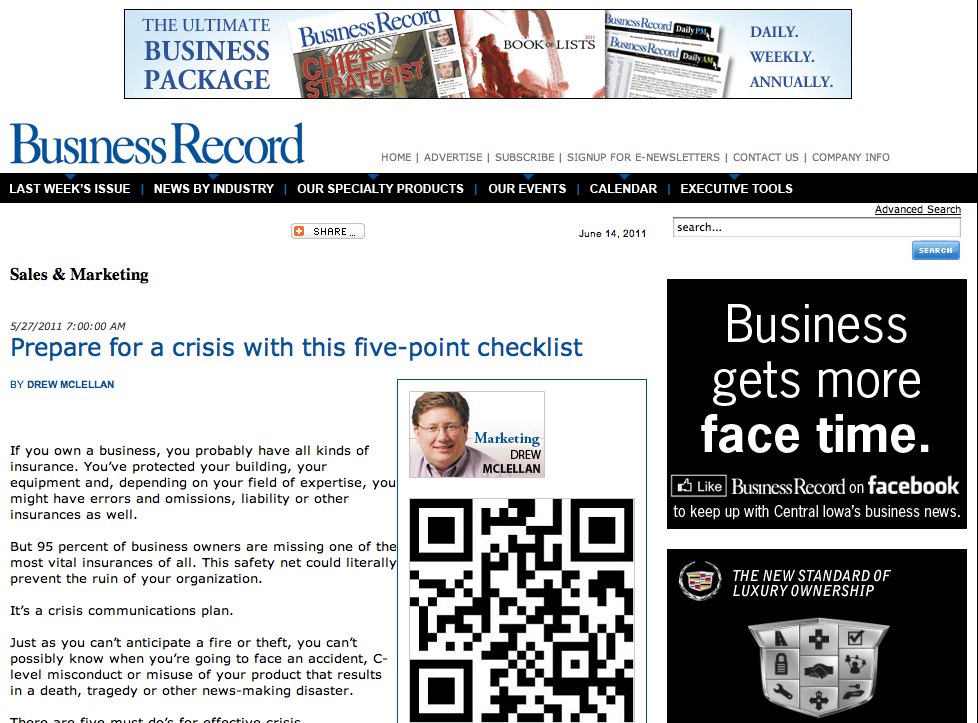
Along with the various online places where you can find my marketing thoughts, I am a weekly columnist for Iowa’s business journal, the Business Record. A few months ago, we started adding a QR code feature to my columns — to share extra resources and to demonstrate how QR codes can work. (the screen capture is of one of my columns that has migrated from their print product to their website)
When we decided to add this feature, I decided I wanted a QR code creator that was a bit more robust than some of the free sites I’d been using. We weren’t ready for custom shapes (check out these designs) — but I did want to know how many scans each code had and if there was a pattern to when the scans were occurring.
After reviewing many options, I am down to two choices. The “must haves” for me were:
The first contender is QReate & Track by InterlinkONE. They do offer a free membership/option but I opted for the $19/month version so I could get the reporting. That reporting includes:
Really, for most local businesses, that’s plenty unless you’re going to do some serious number crunching. In terms of easy access for support, they have a forum, a blog and you can e-mail them your question. They’re also here in the states so for me, that’s a time zone advantage.
The second contender is PushQR.com from the UK. They too offer a free option but I went for the 6.99 GBP($11 something/month) because I needed to create more than 3 campaigns a month. The big difference between the two is in the reporting. With pushqr.com, I can track:
Clearly a more robust reporting menu. One of the other cool features to this site is the ability to set a goal. For example, my QR code could lead you to a landing page where I offered something for sale. The goal URL could be the thank you page that you’d go to after making a purchase. Now the reporting shows me not only how many hit the landing site and where else they went — but how many did what I wanted them to do — buy something.
As for support — they have a very simple online manual to answer the most basic of questions and I can open a ticket and submit a question/request to their team.
I haven’t quite landed on the best option for us at McLellan Marketing Group yet — but both of these providers have served our purposes for now but it’s hard to argue with PushQR’s in depth reporting and lower price.
How about you? Are you creating QR codes? How are you using them? Do you have a favorite tool?
Posted by
ScLoHo (Scott Howard)
2
comments
Links to this post
Labels: internet, magazine, marketing, qr codes, smart phones, websites

Doesn't matter why they are upset as much as what you do next:
Dealing with an Angry Client
Prospects who react strongly to what you present, even with anger, are going to be more involved and passionate about your offerings.
Sometimes the best strategy is to let them vent. Anger is emotional, not logical. Often as prospects vent anger they will not give a logical reason for it.
If you listen carefully for the feeling behind the behavior, the reason may become clear. Responding to the feeling that drives the anger may get you to the heart of the matter.
Source: Adapted from Presentations That Change Minds, by Josh Gordon, president of New York-based Gordon Communication Strategies
Posted by
ScLoHo (Scott Howard)
0
comments
Links to this post
Labels: sales training
Posted by
ScLoHo (Scott Howard)
0
comments
Links to this post
Labels: Advertising
We'll let Pat McGraw explain:
You Don’t Need a Marketing Plan
Posted: 20 Jun 2011 08:30 AM PDT
Back around 2004 or 2005, during a nice bubble, I attended a meeting on behalf of a client that was focused on developing distance learning within the D.C.-Maryland region.
I found myself seated next to a venture capitalist that was working with a $500 million investment firm and, somehow during the course of the conversation, we found ourselves talking about the need for a formal action plan. My position was, as it always will be, that a plan was crucial because we face virtually limitless opportunities with limited resources and in order to maximize the return on those resources, you needed to focus them on what they needed to do in order to succeed.
The VC gave me a rather dismissive look and offered his perspective.
We discourage plans because it prevents the organization from responding to opportunities.
A few years later, most of that particular investment firm’s start-ups were closed. Too much to do, too little to do it with. No money, no business.
Proof, as far as I’m concerned, that you don’t need a marketing plan…unless you want your business to succeed.
Today, I still run into that belief – that a plan prevents the organization from responding to opportunities. And between us, that’s crap. No plan should stop you from responding to opportunities – but it should force you down a path that helps improve your chances for success.
Your plan should help you respond to opportunities more effectively because you know what resources you have, what they are doing and how they are performing – so you can identify what you can redirect onto the opportunity and how it might impact the overall business. Additionally, it should force you to follow the same planning process so that you identify a specific goal and objective, determine strategies and tactics so you can measure performance and determine success (or failure so you can pull the plug and focus on other things).
A plan can be very simple:
Posted by
ScLoHo (Scott Howard)
0
comments
Links to this post
Labels: marketing
from my email:
Daily Sales Tip: Work On Your Weaknesses
Some salespeople work on things they're good at and don't spend enough time trying to overcome weak areas. They can only improve their strengths so much.
Even if they do improve strengths, there's a good chance no one will notice, since slight improvements are hard to spot. Strengths will take salespeople only as far as their weaknesses will allow. Be grateful for your strengths, but work on your weaknesses.
Try to do a "weakness" audit each week. What situations in selling make you uncomfortable? Where does your sales manager suggest improvements are needed? Write them down. When you improve your weaknesses, the difference will be dramatic and visible to everyone.
Source: Adapted from How To Be A Sales Superstar, by Mark Tewart
Posted by
ScLoHo (Scott Howard)
0
comments
Links to this post
Labels: sales training
Click & read:
by Sarah Mahoney
by Karlene Lukovitz
by Aaron Baar
Posted by
ScLoHo (Scott Howard)
0
comments
Links to this post
Labels: marketing
Some interesting insight from Chris Brogan:
On Days You Don’t Feel Like Marketing
Posted: 14 Jun 2011 03:58 AM PDT
I woke up not really feeling like talking about marketing. In fact, I didn’t really want to market at all. Sure, I want buyers, but today, I just wish they’d show up. Only, we both know that never happens, right? But on days you don’t feel like marketing, maybe there’s something else you can do.
Do customer service. Technically, I could stop the post here, and get my point across, but I’ll write a few more words, just to let it sink in. You see, this is the last thing on most marketers’ minds, and yet, it’s the first thing on your buyer’s mind.
Would I trade a clever offer for amazing service? Absolutely. Here’s an example.
A few days ago, I took my daughter to New York City for an adventure. As part of it, we picked out a dress at Bloomingdale’s and a pair of shoes at Payless. At Bloomingdale’s, we were given great service, and had no fewer than two people looking to help us buy a dress.
At Payless, we had a bored employee traipse past us, pretend to ask if we needed help, and then mumble that every shoe in the store is “buy one, get one half off.” We picked out the single pair of shoes we wanted for our efforts, brought them down to the register, where the same employee ignored us for a minute or so before telling us, “I’ll have to get the manager. I can’t ring on these registers.” So, we waited for the manager.
The manager arrived and said, “You know, every shoe in the store is buy one, get the next pair half off.” I said, “Thanks, I’m all good with this pair.” She proceeds to sigh, as if I’m the stupidest buyer in the world and how could I possibly pass up the chance to get another pair of shoes at half off. Then, she slowly (laboriously slowly) scans in my order, and finishes by asking me for four pennies so she can give me back a nickel, as she’s out of pennies in her drawer.
Prior to this experience, I didn’t have high expectations for Payless. It is what it is: discount shoes. But, I never excuse a price point for poor service. That’s just not allowed in my vernacular.
On days you don’t feel like marketing, spend every possible moment thinking about customer service and how you can do it better. Retrain your staff, if you have customer-facing employees. Do something to perk up the experience. Do something to eliminate roadblocks. Whatever. Just do something to bring excellent customer service to your buyers and you’ll find that your marketing isn’t as important on those days.
The same is true for online customer service. Have you made it easy for your buyer to be helped? Look around your site. What are you doing to encourage a sale? I know that when I look around at this site, I’ve got some work to do. But when I look at what we’ve accomplished at Kitchen Table Companies, I see that we’ve done a lot and can do even more to make it a top shelf customer experience.
How about you? What are you doing to improve your customer service?
Sphere: Related Content
Posted by
ScLoHo (Scott Howard)
0
comments
Links to this post
Labels: customer service, marketing