Showing posts with label facebook. Show all posts

Sunday, May 01, 2011

5 ways to Facebook Your Business

First off...

I'm not a fan of Facebook.

I don't agree with this article from Drew.

I am on Facebook, but I use it as a communication tool, not as a business site.

I am also on Twitter and LinkedIn as communication tools.

I believe that you should really have your own website or blog, and then post links to your site on Facebook.

As a matter of fact, one of these days I will be doing a local presentation called Beyond Facebook, Creating a Brand on Social Media.

But for those who wish to just use Facebook, here are tips from Drew:

5 ways to build a sticky Facebook fan page

Posted: 22 Apr 2011 09:33 AM PDT

Screen shot 2011 04 22 at 10 57 13 AM
… The McLellan Marketing Group’s page
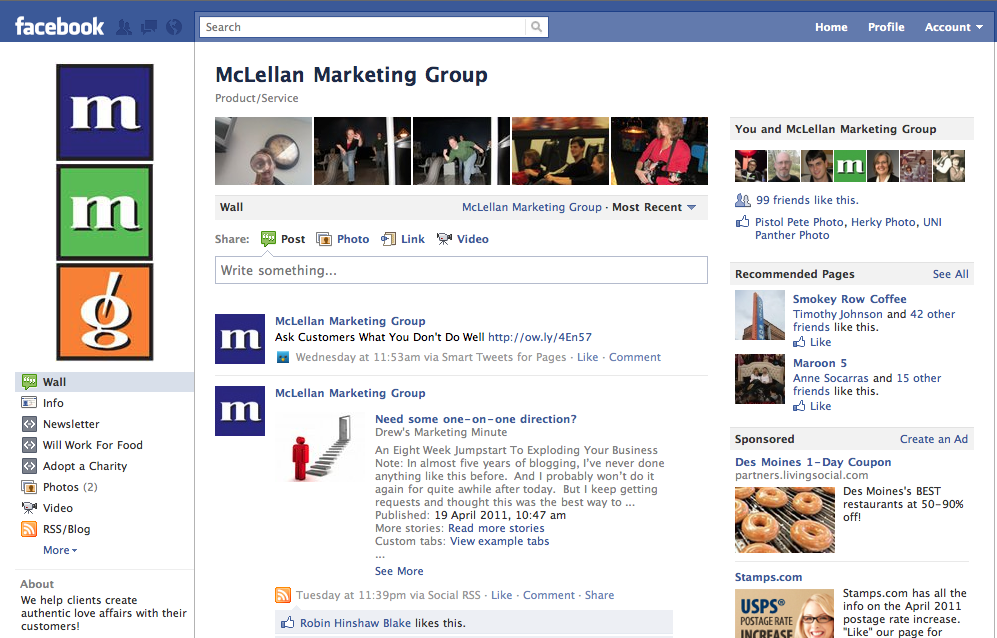
With well over 600 million people on Facebook, it’s no wonder that businesses are flocking there to create a fan page for their organization. But what should that page contain? How should you use it to connect with your customers?

Here are 5 tips for creating a Facebook page that people won’t ignore.

Connected: Be sure you use your Facebook page as a launching point for learning more about your product or service. Link it to your website, a testimonials page or a third-party site that sells your product.

Good example: Ace Hardware offers us special FB discounts, links to their retail locations and you can even view your own local ad flier.

Be the resource: Know your audience well enough to anticipate what else they might want to know. If you sell business training, link to other HR and employee related sites or tools. Think beyond what you specifically sell and build a more well rounded resource center.

Good example: Arbor Springs shares their expertise in dementia by offering a free ebook and other links to resources valuable to families facing this disease. (disclosure — they’re a client and we built the page)

Let them talk: Don’t make the mistake of treating your Facebook page like a one way broadcast tool. One of the best elements of Facebook is that you can actually talk to your customers and prospects. Don’t turn off their ability to comment on your page.

Good example: Check out the questions we get asked on our FB fan page. We might start the question/discussion but sometimes people pop on and ask us something out of the blue. We love that. (disclosure…duh, it’s us)

Let the games begin: No matter how old we are chronologically, we like to play games. One great way to get Facebook page fans or to get them to keep coming back is to create contests and games that hook your audience and keep them coming back for more. Or, have a regular contest –like a weekly trivia game.

Good example: Northwest Savings Bank offers contests and giveaways to their customers.

Serve with a smile: Use your Facebook page as your customer service portal. Let customers ask questions, post problems or give you feedback about your product or service.

Good example: Check out how Scrapbooking for Less customers ask questions about products and classes.

Facebook is a very powerful tool. But just jumping on board and slapping up a page without a strategy will leave you and your page getting chilled from a lack of attention.

Sphere: Related Content

Wednesday, December 29, 2010

Social Media Users

I'm not a big Facebook fan.

But I'm on it, because of it's popularity.

And there is a pretty cool feature that I use to stay in touch with my Facebook Friends, the birthday reminders. I send greetings nearly everyday. It's one of those touch points that helps us to develop and continue building relationships.

Next month, I will be doing a session on Personal Branding at a local University and that will include telling my own story which is due to various forms of Social Media I use.

Today, I have a report from MediaAudit.com on what's going on now and the year ahead:

A Perfect Storm: Social Media Reaches Important Life Stages

The Media Audit FYI
December, 2010

A preliminary analysis of The Media Audit's soon-to-be released 2010 National Report reveals for the first time how social media websites such as Facebook, Twitter, and MySpace have reached critical mass with consumers who are in important life stages. The study, conducted among more than 65,000 consumers across the U.S., reveals that consumers, especially those who are younger and single, or who have young children living at home are visiting Facebook, Twitter, and MySpace at a higher rate when compared to the general population.

The significance of these findings lies in the fact that consumers who are single tend to have a higher disposable income while those who are married with young children are entering the "age of acquisition" in which they are consuming large ticket items such as automobiles, furniture and real estate for the first time. As a result, these audiences represent significant buying power and validate the lure that more and more advertisers are beginning to have with these social sites.

According to the national study, 51.3% of U.S. adults surveyed across The Media Audit's 80 measured markets have visited Facebook, Twitter, or MySpace in the last month. The figure represents more than 71 million adults who are 18 or over. However, among adults who are single, under 35 years old, and with no children, 80.6% have visited these sites. As a result, those consumers in this group are 57% more likely than the general population to visit Facebook, MySpace, or Twitter in a typical month.

The same report reveals that adults under the age of 35 years who are single and have no children have extremely active lifestyles and exhibit upscale shopping behavior, likely the result of not having children, and thus higher disposable income. Furthermore, these consumers are less likely to own a home, thus freeing up more income.

According to the study, adults who are single, under 35 years with no children are 60% more likely to visit bars or night clubs, 51% more likely to frequently attend college or professional sports events and 48% more likely to frequently visit a movie theatre. Furthermore, this group is 25% more likely than the general population to shop at upscale Neiman Marcus and 20% more likely to shop at Nordstrom. Not only is this audience attractive to advertisers, but it is also elusive. According to the same study, adults who are under 35, with no children and single are 47% more likely to be heavy internet users, however they are 12% less likely to be heavily exposed to outdoor billboards, 52% less likely to be heavily exposed to a newspaper, and 13% less likely to be heavily exposed to TV.

Among those adults who have children under the age of six years old, 71% visit Facebook, MySpace, or Twitter in a typical month, a figure that is 38% higher when compared to the general population. Furthermore, households with children under the age of six visit these social websites at a higher rate when compared to households with children older than six years old.

The same national study reveals that households with children under the age of six are more likely to be in the market for new cars, real estate, and household accessories such as new furniture, electronics, and appliances. According to the study, consumers with young children under the age of six are 15% more likely than the general population to be in the market for a new vehicle in the next 12 months, while the same group is 37% more likely to be shopping for new video equipment such as a camera, VCR or DVD player. Additionally, households with young children under the age of six are 69% more likely to be planning to buy a home in the next two years and 11% more likely to be planning a home remodeling project.

Data for this report is preliminary and was obtained from surveys conducted between January and October of 2010 among more than 65,000 respondents. The Media Audit's 2010 National Report will be released this spring after all interviews are concluded for its 80 measured markets. The Media Audit local and national reports represent the most comprehensive and up-to-date analysis of today's constantly changing media and consumer trends.

For more information on this report, or to obtain data on a local market, contact The Media Audit.

Sphere: Related Content

Monday, December 20, 2010

Facebook Friends vs. Twiiter Tweeps

This is a follow up to a survey that I conducted earlier this month.

On December 14th, I shared the results of a survey I conducted about people who use Twitter.

You can read what I wrote here: http://sclohonet.blogspot.com/2010/12/intelligent-tweeps.html

The first survey was shared only on Twitter. A few people (Tweeps, as people on Twitter are sometimes affectionately known) commented and a local University asked if I would also be doing a survey of Facebook Users.

Sure, I said to the folks at the University of Saint Francis. Also on Twitter: http://twitter.com/USFFW/

So I created a nearly identical survey and only sent it out via Facebook.

Please realize that this is not a scientific survey, there was no "Control Group", however there was a safeguard that only allowed a person to take each survey only one time, unlike American Idol where you can vote as many times as you can get through!

This is a snapshot taken in December 2010, sent to the 1200 people who are listed as my followers on Twitter, and 600 people who are friends on Facebook.

Now that I've given you the disclaimers, let's compare...

My theory was that People who Tweet are smarter than People who use Facebook. And one way to test this was to compare which internet browser they used.
UPDATE: Let's amend this to say "More Internet Savvy" instead of the generic "Smarter".

Ever since the days of Windows 95 from Bill Gates and Microsoft became the standard for personal computing 15 years ago for most of the general public, we've had a big blue "E" on our computers which we would click and connect to the internet.

The last few years the dominance of Internet Explorer was dwindled, with the rise of alternative Internet Browsers and the reluctance of "Smart People" to trust Microsoft and/or their Browser.

1st Question:
Which Internet Browser is your favorite?

The Facebook answer:


And the Twitter answer:


Now, I am going to make the Big, Bold, Brash statement that people who use Explorer are dumb.

UPDATE: Let's amend this to say "LessInternet Savvy" instead of the generic "Dumb".

Not about everything, mind you, but at least when it comes to computer usage, using Explorer instead of the other options, (that are FREE) isn't very wise.

21% compared to nearly 4% gives Tweeps an edge in my book.

2nd Question:
What other Internet Browsers do you use?

Facebook answer:


Twitter answer:


What I notice most is the use of Chrome is much higher with Tweeps than their Facebook counterparts.

50% vs. nearly 13%.

Chrome was introduced by Google a few years ago and is pretty cutting edge compared to others.

Now, for the Facebook survey, I decided that I better ask an extra question, that I did not ask on the Twitter Survey:

3rd Question:
Do you also have and use Twitter?

Facebook (only) answer:


From my experience, the most important answer is the second line which shows that less than 10% are using Twitter at least once a day.

My experience with Twitter is any less that once a day is irrelevant. You are not using Twitter, you are playing with Twitter and deciding if it is worthy of your time. And your level of commitment is so low, you'll never really know unless you step up your activity.

4th Question:
Feel free to add your thoughts...

Facebook answer:


Twitter answer:

Now that you've seen the results and my commentary, feel free to add your own two cents in the comments.

Sphere: Related Content